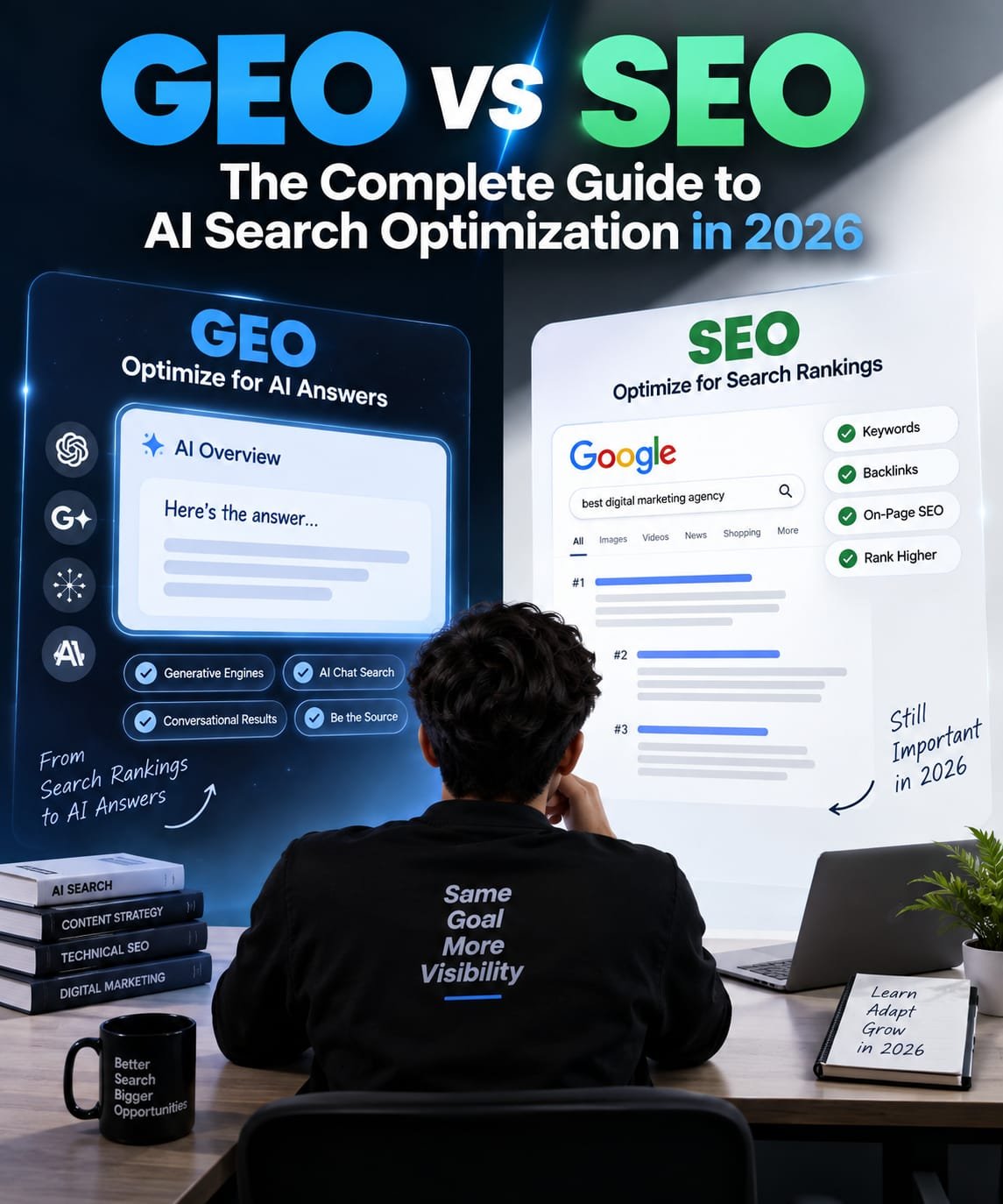
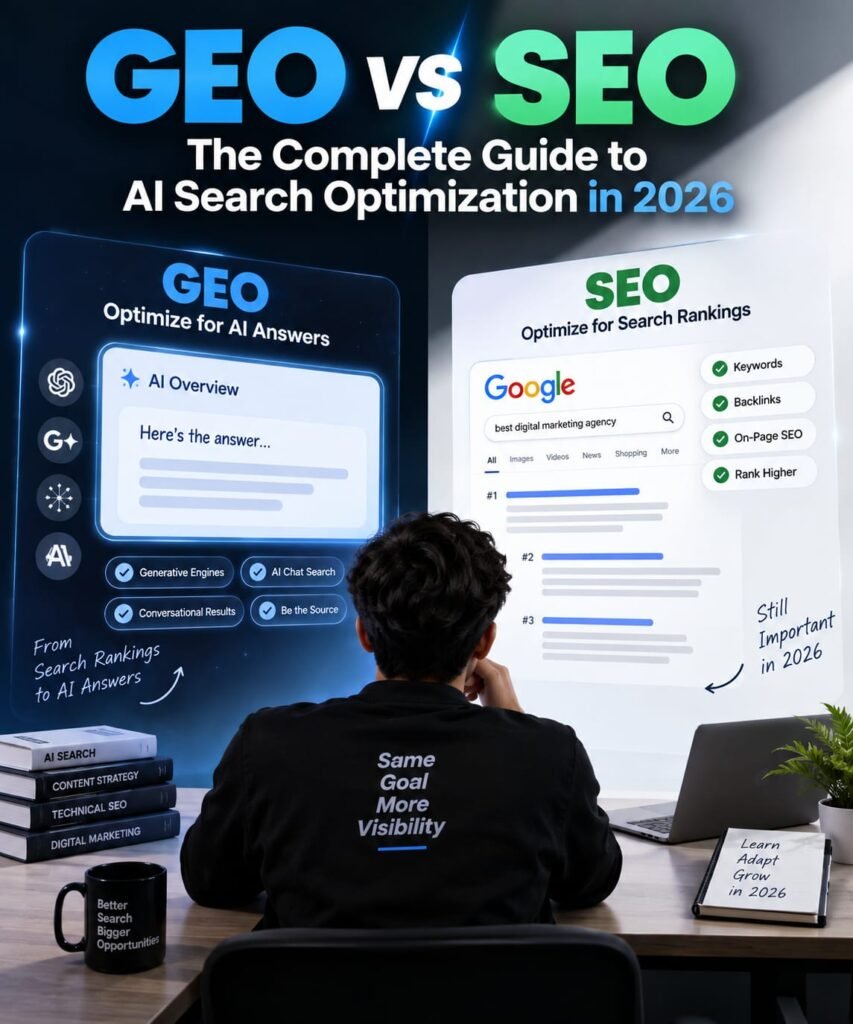
Search is no longer limited to typing a few keywords into Google and choosing a link from the first page. In 2026, users can ask longer, conversational questions and receive AI-generated answers that synthesize information from multiple sources. Google says its AI Mode has already surpassed 1 billion monthly active users globally, while AI Overviews has more than 2.5 billion monthly active users.
This shift is changing how brands need to think about online visibility. GEO vs SEO is not simply a choice between two competing approaches. Traditional SEO remains focused on helping webpages become discoverable and rank in conventional search results, while GEO—Generative Engine Optimization—focuses on increasing the likelihood that a brand’s information is understood, referenced, or surfaced within AI-generated responses.
The difference becomes clearer when we look at how people search. Google reported in 2026 that the average AI Mode query is three times longer than a traditional Search query. More than one in six AI Mode searches also use voice or images, with image searches growing by more than 40% month over month in its U.S. data. This means users are increasingly expressing complete questions, preferences and context rather than relying only on short keyword phrases.
Independent research also highlights the change. A Pew Research Center analysis of 68,879 Google searches found that 18% produced an AI-generated summary. AI summaries appeared much more frequently for longer queries: 53% of searches containing 10 or more words generated one, compared with 8% of one- or two-word searches.
For businesses, this makes GEO vs SEO an important strategic discussion. SEO continues to provide the foundation through technical accessibility, relevant content, internal linking and authority. GEO adds another layer: creating information that is clear, useful, trustworthy and contextually relevant enough to be considered by AI-powered search experiences.
AI is therefore changing not only where people discover brands, but also how discovery happens. Instead of clicking through several pages to research a topic, a user may ask an AI-powered search engine to compare options, explain a service or recommend solutions. Google itself says AI features are creating new kinds of questions and opportunities for brands to reach people.
Understanding GEO vs SEO means recognizing this broader shift: successful digital visibility in 2026 requires businesses to build strong search foundations while also creating authoritative content that can participate in increasingly conversational, AI-powered discovery.
What Is Generative Engine Optimization?
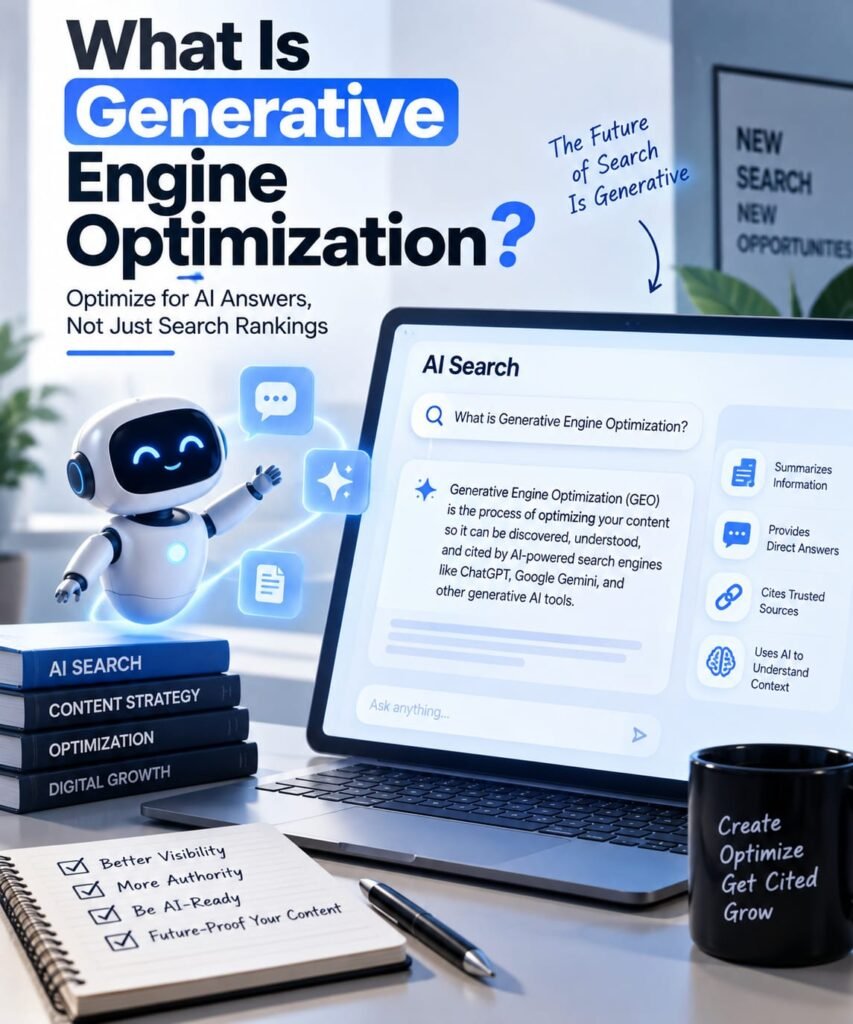
Generative Engine Optimization (GEO) is the practice of creating and structuring online content so that generative AI systems can more easily understand, retrieve, and use it when producing answers for users. Unlike traditional search, where the main objective is often to earn a visible position on a search results page, GEO focuses on making a brand or its information useful and recognizable within AI-generated responses. This is one of the key areas where GEO vs SEO becomes important for modern marketers.
Generative search systems typically process a user’s question, identify the intent and relevant concepts, retrieve information from available sources, and then generate a response based on that information. Instead of simply presenting ten blue links, an AI-powered search experience may combine information from several webpages into a conversational answer. Google’s AI Overviews, for example, can provide an AI-generated summary with links to supporting web sources.
This changes the way content needs to be structured. A page written only around repetitive keywords may not provide enough context for an AI system to understand the subject. Effective GEO focuses on clear explanations, factual accuracy, relevant entities, strong topical coverage, original insights, and information that directly addresses user questions.
The difference between traditional search and generative search is particularly noticeable in the final user experience. Traditional search generally gives users a list of webpages that they can visit and evaluate individually. AI-generated search results can synthesize information from multiple sources before presenting an answer. Google has reported that queries in AI Mode are typically much longer than traditional searches, reflecting more detailed and conversational user questions.
This does not mean GEO vs SEO is an either-or decision. SEO remains important because AI-powered search still depends on discovering and interpreting information available on the web. Google’s guidance also emphasizes creating helpful, reliable, people-first content rather than content designed primarily to manipulate rankings.
Brand authority therefore becomes increasingly significant. If a business consistently publishes accurate, original, expert-level information and earns recognition from credible sources, it provides stronger signals about what the brand represents and what information it can be trusted for. Relevant backlinks, industry mentions, transparent authorship, first-hand experience, and consistent business information can all contribute to a stronger online presence.
Ultimately, GEO vs SEO is better understood as an evolution of search strategy rather than a replacement of one discipline by another. SEO helps establish a strong foundation for discoverability, while GEO focuses on preparing that information for a search environment where AI increasingly interprets, summarizes, and presents information on behalf of the user.
Why GEO Is Important for Businesses in 2026
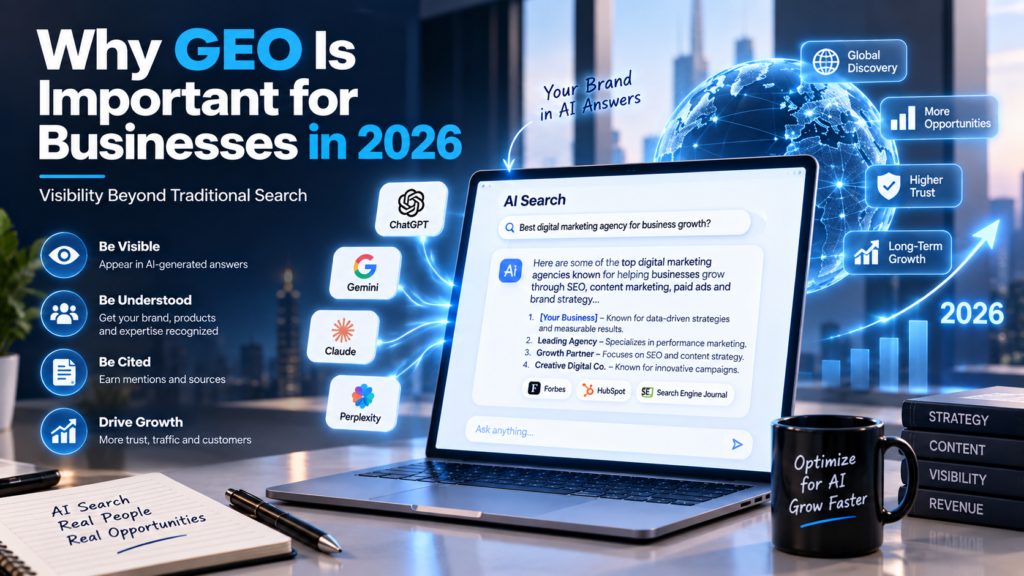
The shift toward AI-powered search is no longer a future prediction—it is already changing how people discover information, products, and businesses. In 2026, Google reports that AI Mode has surpassed 1 billion monthly active users globally, while AI Overviews have reached more than 2.5 billion monthly active users. Google also says AI Mode queries have more than doubled every quarter since its launch.
Lets explore this blog with therohitcreativehub.com
This growth makes GEO vs SEO an important consideration for businesses that depend on online discovery. Traditional SEO remains essential for helping websites become crawlable, relevant, and visible in search. However, GEO addresses another layer of visibility: whether useful information about a business can be understood, referenced, or surfaced by AI-powered search experiences. [Resource] :https://aisearch.similarweb.com/
Changing Consumer Search Behavior
People are also changing the way they search. Instead of entering short phrases such as “digital marketing agency,” users can ask detailed questions like, “Which digital marketing strategy should a small local business use to generate leads?” AI-powered search is designed to handle this conversational behavior.
Google reported in 2026 that AI Mode queries are typically much longer than traditional Search queries. Pew Research Center’s 2026 research also found that 60% of U.S. adults say they have read AI summaries at the top of search-engine results. Among adults aged 18–29, the figure rises to 72%.
For marketers, this means content needs to answer complete questions, provide context, and demonstrate genuine expertise—not simply repeat target keywords.
Why Brand Mentions and Citations Matter
AI search can present information from multiple sources rather than directing users to a single webpage. Pew’s analysis of 68,879 Google searches found that 88% of AI summaries cited three or more sources, while only 1% cited a single source.
This makes brand authority increasingly relevant. Quality content, credible references, industry mentions, and consistent business information can help establish a stronger digital footprint.
Increasing AI Search Visibility
The goal of GEO vs SEO should therefore not be to abandon one strategy for another. Businesses can combine strong technical SEO with useful, authoritative content designed for conversational search. GEO vs SEO is ultimately about adapting to a search environment where users may discover a brand through traditional results, AI summaries, or conversational answers.
For businesses in 2026, investing in GEO vs SEO means preparing for both forms of discovery—building a strong search foundation while making the brand’s expertise easier for AI-powered systems and human users to understand.
GEO vs SEO: What Is the Difference?
The relationship between GEO vs SEO becomes much clearer when we look at how traditional search and AI-powered search actually work. SEO has historically focused on helping webpages become discoverable and rank for relevant queries. GEO, or Generative Engine Optimization, focuses on making information clear, authoritative, and useful enough to be surfaced or referenced within generative search experiences. In practice, these approaches overlap considerably rather than functioning as completely separate systems.
Traditional Search vs Generative Search
Traditional search generally presents a ranked set of webpages for a user’s query. The user chooses which result to open and evaluates the information themselves. Generative search can take a more conversational approach by interpreting a question, exploring multiple sources, and producing a synthesized response.
Google’s AI Mode illustrates this shift. Google says AI Mode uses a technique called query fan-out, where a complex question can be broken into multiple related searches to explore different aspects of a topic.
Keywords vs Conversational Queries
Traditional SEO has historically placed significant emphasis on keywords and search intent. With AI-powered search, users can express their needs in much longer, natural-language questions. Google reported in 2026 that the average AI Mode query is three times longer than a traditional Search query.
Therefore, the GEO vs SEO distinction is partly about moving from isolated keyword targeting toward comprehensive topical coverage and conversational questions.
Search Rankings vs AI-Generated Visibility
SEO commonly measures visibility through rankings, impressions, clicks, and organic traffic. Generative search introduces additional forms of visibility, including whether a brand or webpage is referenced within an AI-generated response.
Google’s latest Search Console updates now provide insights into how webpages appear in generative AI Search features, including impressions and which pages appear in AI responses.
Backlinks vs Broader Brand Authority
Backlinks remain an important part of traditional SEO, but modern search visibility involves more than simply accumulating links. For GEO, businesses should build broader authority through original research, expert content, reputable mentions, first-hand experience, and consistent information across the web.
Google specifically says its generative Search experiences are designed to connect users with original content and trusted sources.
Website Traffic vs AI Mentions and Citations
Website traffic remains a valuable SEO metric, but AI search can introduce another layer: mentions and citations within generated answers. A user may encounter a brand while researching a question through AI and then visit the cited website for deeper information.
This does not make website traffic irrelevant. Google reported that it continues to send billions of clicks to websites and said overall organic click volume was relatively stable year over year in its 2025 analysis.
Traditional SEO Content vs AI-Friendly Content
Traditional SEO content often targets specific keywords and search intents. AI-friendly content still needs those fundamentals, but it should also provide clear answers, strong context, original insights, accurate information, and logical structure.
Ultimately, GEO vs SEO is less about choosing one strategy and more about adapting to multiple search experiences. In 2026, GEO vs SEO represents two connected dimensions of digital visibility: being discoverable in traditional search while also making your expertise understandable and useful within AI-powered search.
How AI Search Results Work
AI search is changing the way people find and consume information online. Instead of simply matching a few keywords with webpages, AI-powered search experiences can understand the meaning behind a question, identify related subtopics, retrieve information from multiple sources, and generate a conversational response. This shift is one of the main reasons the GEO vs SEO conversation has become important for businesses planning their search strategy in 2026.
How AI Search Understands User Questions
Traditional search often starts with matching keywords, while AI search attempts to understand the intent, context, and relationships within a query. For example, a user searching “best digital marketing strategy for a small business with a limited budget” is not necessarily looking for a page containing those exact words. They want practical recommendations based on budget, business size, objectives, and marketing channels.
Google has described how AI Mode uses a technique called query fan-out, where a complex question can be broken into multiple related searches across different subtopics. This allows the system to explore a broader set of information before constructing a response.
This means businesses need to create content that answers real questions comprehensively rather than producing pages designed only around isolated keywords. Understanding search intent becomes increasingly important in the GEO vs SEO landscape.
How AI Systems Identify Relevant Information
Once an AI search system understands the question, it needs to identify information that is relevant to the user’s intent. This can involve search indexes, websites, structured information, knowledge systems, and other sources depending on the platform.
Relevance is not simply about finding a page containing the same phrase. The system may consider how closely the information answers the question, whether the content provides useful context, and whether the source appears reliable. Google has stated that its AI search experiences remain connected to its core information and ranking systems and are designed to surface relevant web content with links for deeper exploration.
How Information From Different Sources Is Synthesized
One of the biggest differences between conventional search and generative search is synthesis. Instead of asking users to open several pages and compare the information themselves, AI search can process information from multiple sources and present a consolidated response.
For example, a complex question about SEO trends could require information about search behavior, content strategy, technical SEO, and AI search developments. An AI system may investigate these different areas and then organize the findings into one response.
Google’s query fan-out approach is specifically designed to perform multiple searches across subtopics before bringing the information together.
Why Accurate and Authoritative Information Matters
AI-generated answers still depend on the quality of the information available to the system. If content is outdated, inaccurate,
AI Search Optimization: How to Prepare Your Website
Preparing a website for AI-powered search requires more than adding keywords to existing pages. Search systems are increasingly designed to understand questions, context, entities, and relationships between topics. As a result, businesses need content that is useful for people while also being clear and understandable to modern search systems. This is where GEO vs SEO becomes a practical consideration for website owners.
Create Helpful and Original Content
Start by publishing content that genuinely solves problems instead of simply targeting search terms. Original explanations, examples, research, case studies, practical guides, and firsthand experiences can give your website stronger informational value.
Avoid creating large volumes of generic AI-generated pages that repeat information already available elsewhere. Focus on adding something useful that readers cannot easily get from another page.
Answer Real Customer Questions
Your customers are often the best source of content ideas. Identify questions they ask before purchasing, during the decision-making process, and after becoming customers.
For example, a digital marketing agency could answer questions such as “How much does SEO cost?”, “How long does SEO take?”, or “Should a small business use Google Ads or social media advertising?”
Creating direct answers can help your content match the informational needs behind real searches.
Optimize for Conversational Queries
AI search has made conve
GEO Optimization: Strategies to Improve AI Visibility
Getting visibility in AI-powered search requires a content strategy built around relevance, clarity, authority, and trustworthy information. GEO optimization is not simply about inserting keywords into webpages. It is about making useful information easier for AI-powered search experiences to understand, connect, and potentially reference when answering relevant user questions. This makes the relationship between GEO vs SEO increasingly important for businesses competing for online visibility in 2026.
Create Content Around Specific User Questions
Start with the questions your target audience actually asks. Instead of creating broad articles that attempt to cover everything, develop focused content that provides clear answers to specific problems.
For example, rather than writing only about “social media marketing,” create useful resources around questions such as “How can a small business generate leads through Instagram?” or “How often should a business post on social media?”
Question-focused content gives search systems clearer context while also making the information more useful for readers.
Strengthen Brand Authority
AI visibility is closely connected to the o
How to Rank in AI Search
As AI-powered search becomes more conversational, businesses are looking beyond traditional blue-link rankings and asking a new question: how to rank in AI search? The answer is not a single optimization technique. AI search visibility depends on a combination of useful content, topical relevance, technical accessibility, credibility, and a strong overall online presence. This is an important part of understanding GEO vs SEO in 2026.
Understand Conversational Search Queries
People often interact with AI search differently from traditional search. Instead of entering a short phrase such as “SEO services,” they may ask, “What SEO services does a small business need to increase its visibility?”
This means businesses should research longer, conversational queries and understand the intent behind them. Create content that directly addresses complete questions rath
Montior your brand’s AI search visibility
How to Get Featured in AI Search Results
As AI-powered search becomes more common, businesses are increasingly interested in how to get featured in AI search results. Unlike a traditional search result, where a webpage may appear at a specific ranking position, an AI-generated answer can select and synthesize information from multiple sources. This makes the goal less about achieving a guaranteed position and more about becoming a useful, relevant, and trustworthy source of information. Understanding this difference is an important part of GEO vs SEO.
Create Content That AI Systems Can Understand
Start with content that is logically organized and easy to interpret. Explain important concepts clearly, avoid unnecessary jargon, and keep each section focused on a specific subject.
Use descriptive page titles, relevant headings, concise explanations, examples, supporting evidence, and natural language. The objective is not to write content exclusively for AI, but to make information clear enough for both users and search systems to understand.
Use Clear Headings and Direct Answers
Well-structured content makes it easier for readers to find information and helps establish the context of different sections.
For question-based content, consider answering the question directly near the beginning of the section before providing additional explanation. For example, a heading such as “What Is Generative Engine Optimization?” should be followed by a clear definition before moving into advanced details.
This approach is particularly useful when exploring how to get featured in AI search results, because AI systems need to identify which parts of a webpage are relevant to a particular question.
Establish Your Brand as a Reliable Source
AI visibility should be supported by genuine authority. Clearly communicate your expertise, experience, services, autho
SEO for AI Search: Does Traditional SEO Still Matter?
With the growth of AI-powered search, some businesses assume that traditional SEO is becoming less important. In reality, SEO for AI search still starts with many of the same fundamentals that have always helped search engines discover, access, understand, and evaluate websites. The difference is that AI-powered search can use this information in more conversational and generative experiences. This makes the relationship between GEO vs SEO complementary rather than competitive.
Why Technical SEO Remains Important
AI systems cannot reliably use information from webpages they cannot properly access or understand. Technical SEO helps create the foundation required for search engines to discover and process website content.
A technically healthy website should have logical navigation, accessible pages, appropriate metadata, mobile-friendly layouts, good performance, and a clear site architecture. These fundamentals remain relevant even as the search interface changes.
Google has stated that its AI search experiences are built on its existing search and information systems and continue to connect users with relevant websites.
Crawlability and Indexability
Crawlability determines whether search-engine systems can access your webpages, while indexability determines whether eligible content can be stored and considered within search systems.
Check for issues such as accidental noindex directives, blocked resources, broken links, incorrect canonical tags, or poor site architecture. An important page should be technically accessible before expecting it to gain visibility through either traditional or AI-powered search.
Website Structure
A logical website structure helps users and search systems understand the relationship between different pages.
Organize content into clear categories, use descriptive URLs, create meaningful navigation, and connect related pages through contextual internal links. A well-structured website also makes it easier to build topic clusters around important areas of expertise.
Page Quality
Technical accessibility alone is not enough. The actual information on the page needs to be useful, accurate, original, and relevant to the user’s intent.
Google’s current AI Search guidance emphasizes unique, non-commodity content and a good page experience. Its AI experiences are also increasingly designed to help users discover original content and trusted sources.
This is where GEO vs SEO becomes especially important: technical SEO can help a page become discoverable, while high-quality content gives search systems useful information to understand and potentially surface.
Internal Linking
Internal links help connect related information across your website. For example, an article about SEO can link naturally to pages covering keyword research, technical SEO, local SEO, content strategy, and AI search optimization.
This creates clearer relationships between topics and helps users move
GEO vs SEO: Can Businesses Use Both Strategies?
The discussion around GEO vs SEO often makes businesses think they need to choose one strategy. In practice, SEO and GEO address different aspects of modern search visibility. Traditional SEO helps websites become discoverable, technically accessible, and visible in organic search, while GEO focuses on making information useful and understandable within AI-powered search experiences.
For businesses building a long-term digital strategy, combining both approaches can create a broader search visibility framework.
SEO Provides Organic Visibility
Search engine optimization remains the foundation of website discovery. Effective SEO helps businesses improve their presence in traditional organic search results by addressing content quality, search intent, technical accessibility, website structure, internal linking, and external authority.
A strong SEO strategy can contribute to:
- Organic visibility across traditional search results
- Search traffic from users actively looking for relevant information
- Website authority developed through useful content and reputable references
- Technical discoverability through crawlable and indexable webpages
These fundamentals remain important even as search interfaces become more conversational.
GEO Adds AI Search Visibility
Generative Engine Optimization builds on many of these foundations while focusing specifically on AI-driven discovery.
GEO-oriented content aims to make information easier for generative search systems to understand and potentially use when responding to relevant questions. This can involve:
- AI search visibility when users ask conversational questions
- Brand mentions within AI-generated responses where applicable
- Citations and references to relevant webpages or sources
- Conversational discovery based on questions rather than only short keywords
Google’s AI search experiences can provide links to relevant web content, allowing users to explore sources behind or alongside generated responses.
Why the Combined Approach Matters
The relationship between GEO vs SEO is therefore better understood as an evolution of search optimization rather than a competition between two completely separate disciplines.
A business could have excellent traditional rankings but limi
Common GEO and AI Search Optimization Mistakes
As businesses adapt to AI-powered search, it is easy to focus too heavily on visibility and forget the fundamentals of good content. GEO vs SEO is not about finding shortcuts to appear in AI-generated answers. Sustainable visibility comes from useful information, technical accessibility, relevance, and credibility. Avoiding common optimization mistakes can help businesses build a stronger foundation for both traditional and AI search.
Keyword Stuffing
Repeating the same keyword excessively does not make content more relevant. It can make writing unnatural and reduce the quality of the reader’s experience.
Instead of forcing phrases such as “GEO vs SEO” into every paragraph, use keywords naturally while covering related concepts, questions, entities, and user intent. Write for clarity first and optimize where it genuinely improves understanding.
Publishing Generic AI-Generated Content
AI tools can accelerate research, brainstorming, and content production, but simply publishing generic AI-generated articles can result in repetitive and low-value information.
Use AI as a productivity tool rather than a substitute for expertise. Add original insights, examples, data, firsthand experiences, expert review, and useful analysis that makes the content genuinely valuable.
Copying Competitors
Rewriting a competitor’s article with different wording does not create meaningful originality. It can also leave your website competing with many pages that provide essentially the same infor
How to Measure AI Search Visibility in 2026
Measuring AI search performance is different from tracking traditional keyword rankings. In conventional SEO, businesses can monitor rankings, impressions, clicks, and organic traffic. AI-powered search can introduce additional signals such as brand mentions, citations, and visibility across conversational questions. This makes measurement an important part of the GEO vs SEO strategy.
There is currently no single universal metric that represents “AI search ranking.” Instead, businesses should monitor multiple indicators to understand whether their content and brand are becoming more visible across AI-powered search experiences.
Brand Mentions
Track how frequently your brand appears when users ask relevant questions about your industry, services, products, or category.
For example, a digital marketing agency could monitor questions such as “best digital marketing services for small businesses” or “how to choose a social media marketing agency.”
Regular monitoring can help identify which topics and questions are associated with your brand.
AI Citations
Citations and linked references can provide another useful signal. When an AI-powered search experience references a webpage as a source, that can indicate that the content was considered relevant to a particular query.
Google has introduced Search Console insights designed to provide website owners with more information about how their pages appear in AI search responses.
However, citation frequency should not be treated as a standalone measure of success. The quality and relevance of the queries generating those citations also matter.
Visibility for Target Questions
Create a list of important conversational questions related to your business and periodically test how your brand and content appear for those questions.
Track whether your website is:
- Mentioned in the response
- Linked as a source
- Associated with the relevant topic
- Absent from the response
- Replaced by competing sources
This creates a practical way to monitor AI search visibility without relying on a traditional blue-link ranking position.
Organic Search Traffic
Traditional organic traffic remains important. AI search does not eliminate the value of visitors arriving directly from search engines.
Monitor organic sessions, landing pages, impressions, clicks, click-through rates, and conversions. Google has reported that overall organic click volume to websites remained relatively stable year over year while AI search continued expanding, although results vary by query and website.
Branded Searches
An increase in searches containing your brand name can indicate growing awareness or demand. Track branded queries separately from non-branded searches to understand whether people are actively looking for your company.
For example, compare searches for your brand name with broader queries related to your services or industry.
Referral Traffic
Monitor traffic arriving from AI-powered platforms and other external sources where referral data is available. Analyze which pages receive these visits and what visitors do after arriving.
Referral traffic can reveal whether AI-generated discovery is producing meaningful website engagement rather than simply generating mentions.
Leads and Conversions
Visibility is useful, but business outcomes provide additional context. Track form submissions, calls, enquiries, purchases, bookings, downloads, or other meaningful conversions.
A page that receives fewer visits but generates highly relevant leads may be more valuable than a page receiving large amounts of low-intent traffic.
Changes in Search Visibility
Finally, compare AI-related visibility with traditional SEO performance over time. Monitor organic impressions, rankings, clicks, branded searches, AI mentions, citations, referral traffic, and conversions together.
This broader measurement framework is central to GEO vs SEO because neither AI mentions nor traditional rankings tell the entire story on their own.
A practical reporting cycle could look like:
Track → Compare → Identify → Improve → Re-measure
Track your important questions and SEO metrics, compare performance over time, identify content gaps, improve relevant pages, and then measure the changes again.
The goal of GEO vs SEO measurement is not simply to count how many times a brand appears in AI answers. The real objective is to understand whether improved visibility is increasing relevant discovery, website engagement, brand awareness, and ultimately meaningful business results.
GEO vs SEO: What Does the Future of Search Look Like?
The future of search is moving from simple keyword matching toward a more conversational and context-driven experience. People are increasingly asking detailed questions, comparing options, researching complex topics, and expecting search engines to help synthesize information rather than simply provide a list of webpages.
This does not mean traditional search is disappearing. Instead, the relationship between GEO vs SEO is likely to become more interconnected as search engines combine conventional results with AI-generated answers and conversational interfaces.
Shift From Keywords Toward Conversations
Search queries are becoming more descriptive and conversational. Users can provide additional context about their situation instead of entering only two or three keywords.
Google reports that queries in AI Mode are, on average, around three times longer than traditional Google searches.
For businesses, this means understanding the questions behind keywords will become increasingly important. Content should address complete user problems, follow-up questions, comparisons, and specific use cases rather than focusing exclusively on exact-match phrases.
Growth of AI-Powered Search
AI is becoming a larger part of mainstream search. Google reported in 2026 that AI Overviews were reaching more than 2.5 billion monthly active users, while AI Mode had surpassed 1 billion monthly active users globally.
These figures indicate that generative search experiences are no longer simply experimental features. They are becoming part of how people discover and interact with information online.
Importance of Topical Authority
As search becomes more context-driven, covering a subject comprehensively can become increasingly valuable. A website that consistently publishes useful information across related subtopics can provide stronger context than one containing isolated pages targeting individual keywords.
This makes topic clusters, internal linking, original research, detailed guides, and genuinely useful supporting content important components of a future-focused search strategy.
Increasing Role of Brand and Entity Recognition
Search systems increasingly need to understand not just webpages, but the entities and concepts represented by those webpages.
For businesses, this means maintaining consistent information about the organization, services, products, authors, expertise, and relevant
GEO and AI Search Optimization Checklist for 2026
Optimizing a website for modern search is not a one-time task. As AI-powered search continues to evolve, businesses need to regularly review their content, technical SEO, authority, and visibility. The following GEO and AI search optimization checklist provides a practical framework for improving your website’s readiness for both traditional and generative search.
✅ Create Original Content
Publish useful content that adds something beyond information already available elsewhere. Include original insights, examples, research, case studies, firsthand experiences, and expert perspectives wherever relevant.
✅ Answer Real User Questions
Research the questions your customers actually ask. Build content around their problems, concerns, comparisons, and decision-making needs instead of creating articles solely around keywords.
✅ Optimize for Search Intent
Understand what users are trying to accomplish with a query. Determine whether they are looking for information, comparing options, evaluating a service, solving a problem, or preparing to make a purchase.
✅ Improve Technical SEO
Make sure important webpages can be discovered, crawled, and understood. Review site architecture, mobile usability, page performance, metadata, internal links, canonicalization, indexability, and other relevant technical elements.
✅ Build Topical Authority
Cover important subjects comprehensively rather than publishing unrelated articles. Develop pillar pages and supporting content that address different aspects of your core topics.
✅ Earn Relevant Backlinks
Focus on earning links from reputable and relevant websites. Industry publications, professional organizations, useful resources, partnerships, and genuine editorial mentions can contribute to a stronger online presence.
✅ Strengthen Brand Authority
Clearly communicate who your business is, what it does, who it serves, and what expertise it provides. Maintain consistent business information and demonstrate credibility through useful content, experience, case studies, and trustworthy references.
✅ Structure Content Clearly
Use descriptive headings, short paragraphs, lists, tables, FAQs, and direct answers where appropriate. A clear structure helps readers navigate information and makes relationships between different topics easier to understand.
✅ Keep Information Accurate and Updated
Regularly review important pages for outdated statistics, broken links, old examples, incorrect business information, and changes in products or services. Accuracy becomes particularly important when content may be used to answer information-seeking queries.
✅ Monitor AI Search Visibility
Track relevant conversational questions and monitor whether your brand or webpages are being mentioned or cited in AI-powered search experiences where measurable. Combine these observations with traditional SEO metrics such as impressions, clicks, rankings, organic traffic, branded searches, leads, and conversions.
A Simple 2026 Workflow
Use this checklist as an ongoing cycle:
Create → Optimize → Build Authority → Monitor → Update → Improve
The goal is not to manipulate AI systems or guarantee inclusion in generated answers. Instead, build a website that consistently provides accurate, original, authoritative, and useful information.
This is the practical foundation of GEO vs SEO in 2026. Strong technical SEO helps search engines discover and understand your website, while GEO-oriented practices focus on conversational relevance, topical depth, clear answers, and broader brand context.
Businesses that consistently follow these principles can build a more resilient search strategy—one designed not just for today’s search results, but for the increasingly conversational and AI-powered way people discover information online.
Conclusion: GEO vs SEO in 2026
Search is changing quickly, but one thing remains clear: businesses still need to be discoverable, useful, and trustworthy. The difference is that people are no longer finding information only through traditional search results. AI-powered search experiences are changing how users ask questions, compare options, discover brands, and make decisions. This is where understanding GEO vs SEO becomes increasingly important.
SEO continues to provide the foundation for online visibility. Technical SEO helps search engines crawl and understand a website, while keyword research, useful content, internal linking, backlinks, and strong site structure help establish relevance and authority. Even as AI search grows, businesses still need technically accessible websites and high-quality information that traditional search engines can understand.
GEO, or Generative Engine Optimization, focuses on making information easier for AI-powered search systems to understand, interpret, and potentially reference when generating answers. Instead of focusing only on where a webpage appears in a conventional results page, GEO considers factors such as clear explanations, contextual relevance, trustworthy information, original insights, and brand authority. This makes GEO vs SEO less about choosing one strategy and more about understanding two connected aspects of modern search visibility.
The growing importance of GEO does not mean businesses should abandon SEO. In fact, strong SEO can support AI search visibility by making websites technically sound, well-structured, authoritative, and easy to understand. At the same time, GEO encourages businesses to think beyond individual keywords and create content that genuinely answers the questions people are asking.
For businesses in 2026, the practical approach to GEO vs SEO is therefore not “either-or.” A stronger strategy combines both. Build a technically healthy website, understand search intent, create original and helpful content, develop topical authority, earn relevant mentions and backlinks, maintain accurate information, and regularly update important pages. Then monitor how your brand appears across both traditional and AI-powered search experiences.
Ultimately, successful GEO vs SEO strategies have the same underlying principle: create information that deserves to be found. Shortcuts and keyword stuffing may produce temporary signals, but useful, authoritative, accurate, and trustworthy content provides a stronger foundation for long-term visibility.
The future of search is likely to become more conversational and AI-assisted, but the fundamentals of earning trust remain important. Businesses that consistently provide genuinely useful information will be better positioned to adapt as search continues to evolve.