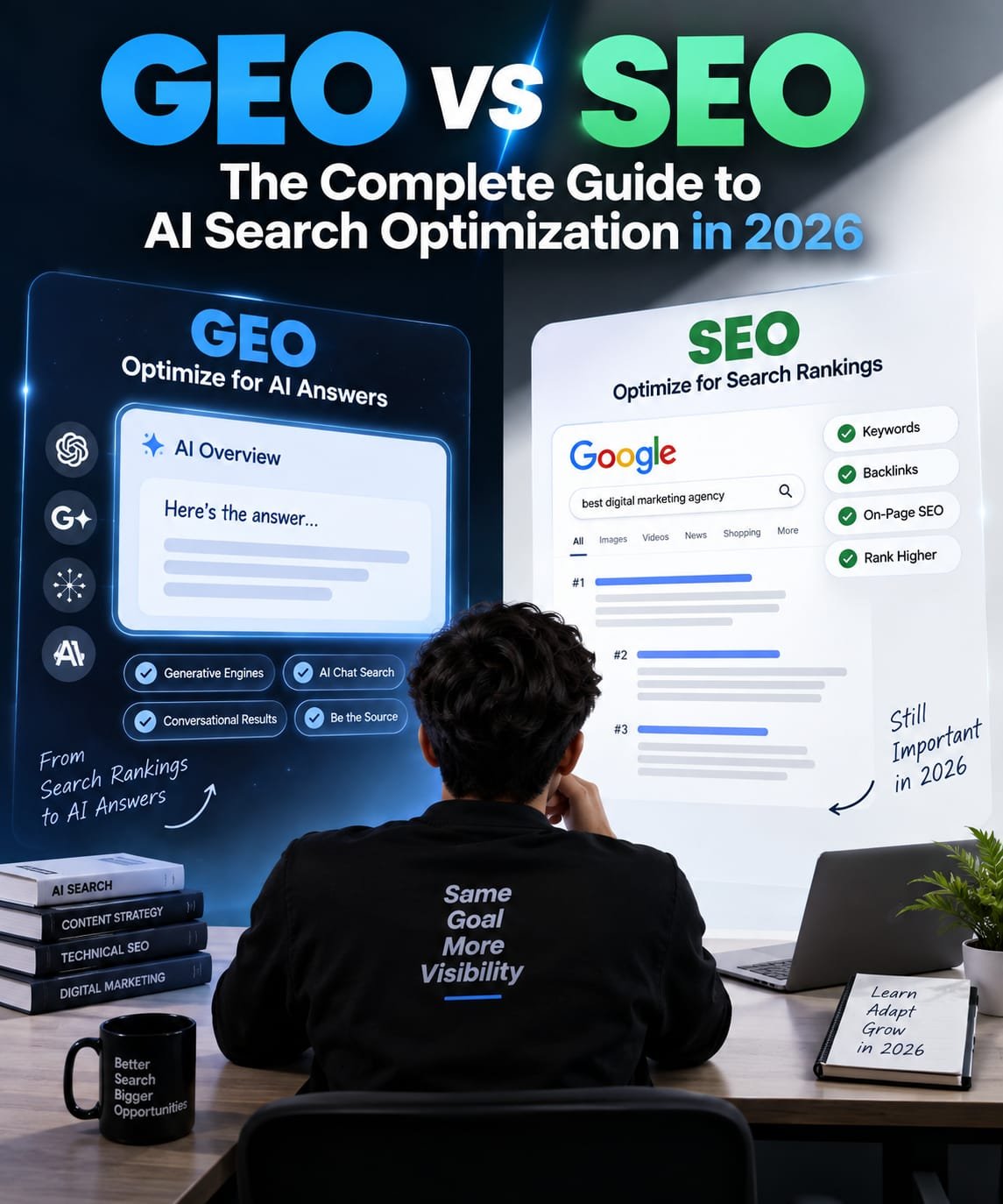
GEO vs SEO: The Complete Guide to AI Search Optimization in 2026
Search is no longer limited to typing a few keywords into Google and choosing a link from the first page. In 2026, users can ask longer, conversational questions and receive AI-generated answers that synthesize information from multiple sources. Google says its AI Mode has already surpassed 1 billion monthly active users globally, while AI Overviews has more than 2.5 billion monthly active users. This shift is changing how brands need to think about online visibility. GEO vs SEO is not simply a choice between two competing approaches. Traditional SEO remains focused on helping webpages become discoverable and rank in conventional search results, while GEO—Generative Engine Optimization—focuses on increasing the likelihood that a brand’s information is understood, referenced, or surfaced within AI-generated responses. The difference becomes clearer when we look at how people search. Google reported in 2026 that the average AI Mode query is three times longer than a traditional Search query. More than one in six AI Mode searches also use voice or images, with image searches growing by more than 40% month over month in its U.S. data. This means users are increasingly expressing complete questions, preferences and context rather than relying only on short keyword phrases. Independent research also highlights the change. A Pew Research Center analysis of 68,879 Google searches found that 18% produced an AI-generated summary. AI summaries appeared much more frequently for longer queries: 53% of searches containing 10 or more words generated one, compared with 8% of one- or two-word searches. For businesses, this makes GEO vs SEO an important strategic discussion. SEO continues to provide the foundation through technical accessibility, relevant content, internal linking and authority. GEO adds another layer: creating information that is clear, useful, trustworthy and contextually relevant enough to be considered by AI-powered search experiences. AI is therefore changing not only where people discover brands, but also how discovery happens. Instead of clicking through several pages to research a topic, a user may ask an AI-powered search engine to compare options, explain a service or recommend solutions. Google itself says AI features are creating new kinds of questions and opportunities for brands to reach people. Understanding GEO vs SEO means recognizing this broader shift: successful digital visibility in 2026 requires businesses to build strong search foundations while also creating authoritative content that can participate in increasingly conversational, AI-powered discovery. What Is Generative Engine Optimization? Generative Engine Optimization (GEO) is the practice of creating and structuring online content so that generative AI systems can more easily understand, retrieve, and use it when producing answers for users. Unlike traditional search, where the main objective is often to earn a visible position on a search results page, GEO focuses on making a brand or its information useful and recognizable within AI-generated responses. This is one of the key areas where GEO vs SEO becomes important for modern marketers. Generative search systems typically process a user’s question, identify the intent and relevant concepts, retrieve information from available sources, and then generate a response based on that information. Instead of simply presenting ten blue links, an AI-powered search experience may combine information from several webpages into a conversational answer. Google’s AI Overviews, for example, can provide an AI-generated summary with links to supporting web sources. This changes the way content needs to be structured. A page written only around repetitive keywords may not provide enough context for an AI system to understand the subject. Effective GEO focuses on clear explanations, factual accuracy, relevant entities, strong topical coverage, original insights, and information that directly addresses user questions. The difference between traditional search and generative search is particularly noticeable in the final user experience. Traditional search generally gives users a list of webpages that they can visit and evaluate individually. AI-generated search results can synthesize information from multiple sources before presenting an answer. Google has reported that queries in AI Mode are typically much longer than traditional searches, reflecting more detailed and conversational user questions. This does not mean GEO vs SEO is an either-or decision. SEO remains important because AI-powered search still depends on discovering and interpreting information available on the web. Google’s guidance also emphasizes creating helpful, reliable, people-first content rather than content designed primarily to manipulate rankings. Brand authority therefore becomes increasingly significant. If a business consistently publishes accurate, original, expert-level information and earns recognition from credible sources, it provides stronger signals about what the brand represents and what information it can be trusted for. Relevant backlinks, industry mentions, transparent authorship, first-hand experience, and consistent business information can all contribute to a stronger online presence. Ultimately, GEO vs SEO is better understood as an evolution of search strategy rather than a replacement of one discipline by another. SEO helps establish a strong foundation for discoverability, while GEO focuses on preparing that information for a search environment where AI increasingly interprets, summarizes, and presents information on behalf of the user. Why GEO Is Important for Businesses in 2026 The shift toward AI-powered search is no longer a future prediction—it is already changing how people discover information, products, and businesses. In 2026, Google reports that AI Mode has surpassed 1 billion monthly active users globally, while AI Overviews have reached more than 2.5 billion monthly active users. Google also says AI Mode queries have more than doubled every quarter since its launch. Lets explore this blog with therohitcreativehub.com This growth makes GEO vs SEO an important consideration for businesses that depend on online discovery. Traditional SEO remains essential for helping websites become crawlable, relevant, and visible in search. However, GEO addresses another layer of visibility: whether useful information about a business can be understood, referenced, or surfaced by AI-powered search experiences. [Resource] :https://aisearch.similarweb.com/ Changing Consumer Search Behavior People are also changing the way they search. Instead of entering short phrases such as “digital marketing agency,” users can ask detailed questions like, “Which digital marketing strategy should a small local business use to generate leads?” AI-powered search is designed to handle this conversational behavior. Google
GEO vs SEO: The Complete Guide to AI Search Optimization in 2026 Read More »