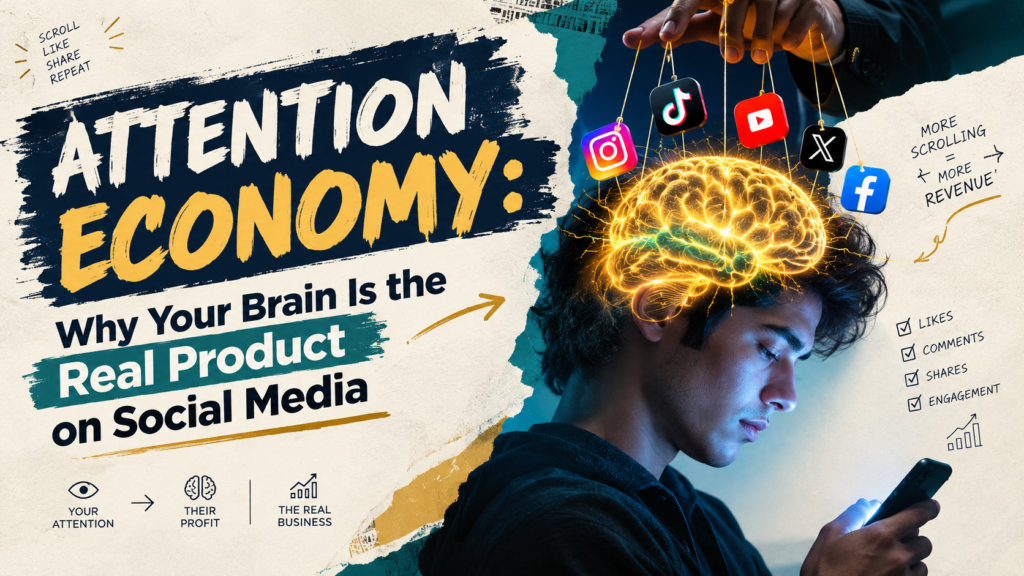
Have you ever opened Instagram just to check one notification and suddenly realized that 30 minutes have passed? That simple experience explains a major idea behind the Attention Economy. In today’s digital world, your attention has become a resource that businesses, social media platforms, creators, and advertisers actively compete for.
The Attention Economy is based on a simple principle: human attention is limited, while the amount of digital content available is practically unlimited. You can scroll through thousands of posts, watch endless short videos, read news, respond to messages, and explore advertisements—but you cannot give all of them your full attention. Because attention is scarce, it has economic value.
The scale of this digital environment is massive. According to DataReportal’s 2026 global data, there were approximately 5.79 billion active social media user identities worldwide in April 2026, equivalent to around 69.9% of the global population. The same research estimates that the average global social media user spends around 18 hours and 36 minutes per week using social media and online video platforms such as YouTube, TikTok, Instagram, and Facebook.
This is where the Attention Economy becomes particularly important. Social media platforms are designed not simply to give you content, but to keep you engaged with content that is likely to hold your interest. Personalized recommendations, autoplay, notifications, infinite scrolling, trending topics, and algorithm-driven feeds all help platforms compete for more of your time and focus.
But where does the money come from? For many platforms, advertising is at the center of the model. Meta, for example, reported $196.18 billion in advertising revenue in 2025, while its total revenue was about $200.97 billion. Meta also reported that ad impressions increased by 12% during 2025.
The numbers reveal something important: your attention is not merely time spent online—it can become a measurable commercial asset. The longer users remain engaged, the more opportunities platforms have to deliver advertisements and optimize their services around user behavior.
So, when we talk about the Attention Economy, we are really talking about the business of human focus. The question is no longer just what are you looking at? It is also who benefits from keeping you looking? Understanding that question helps explain why social media feels so difficult to put down—and why your attention may be one of the most valuable things
Introduction: What Is the Attention Economy?
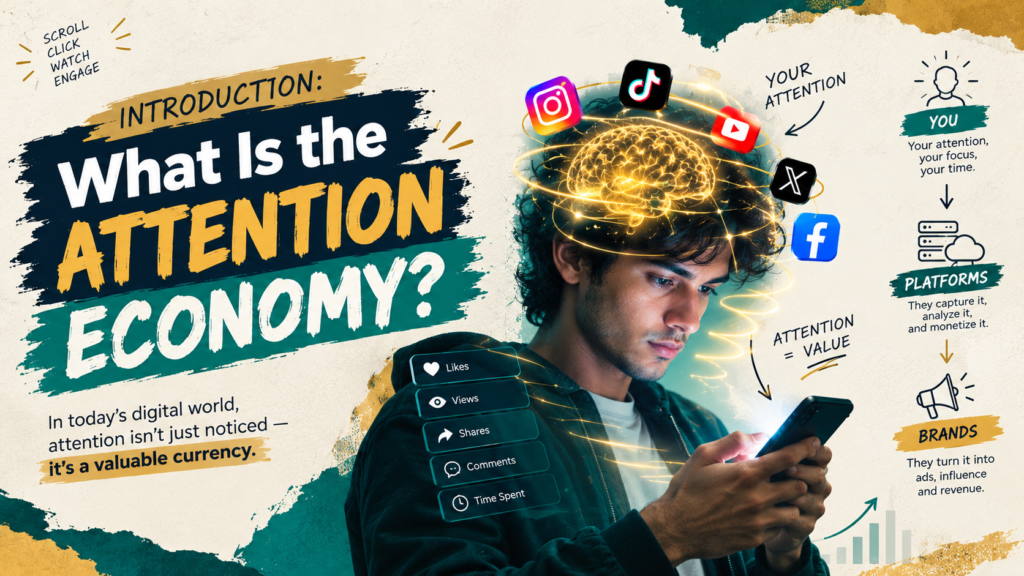
The Attention Economy is the idea that human attention is a limited resource, and digital platforms compete to capture, hold, and monetize it. Unlike money, attention cannot be saved or increased. Every person has only a finite number of waking hours, which makes focus one of the most valuable assets in the digital world. As more activities move online, businesses are no longer competing only for customers; they are competing for seconds of those customers’ attention.
The scale of this competition is enormous. DataReportal’s 2026 research reports 5.79 billion active social media user identities worldwide, equivalent to about 69.9% of the global population. GWI data also shows that online adults spend more than 2.5 hours a day consuming social and video feeds such as Facebook, Instagram, YouTube, and TikTok, adding up to approximately 18 hours and 36 minutes per week.
Attention as a Limited Resource
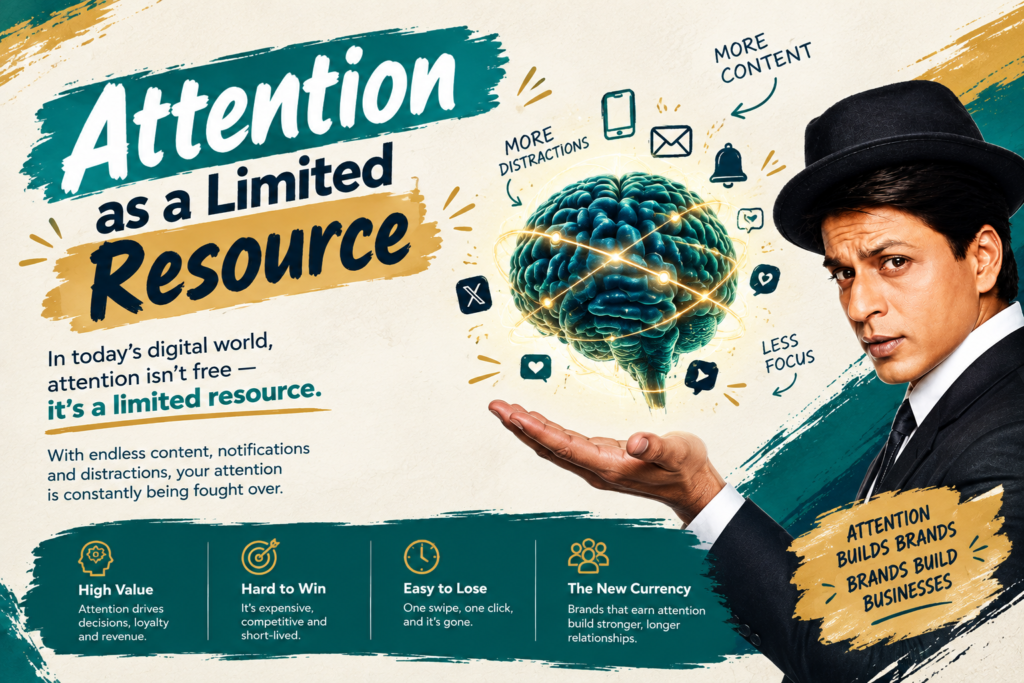
Think about your daily routine. You may have unlimited content available, but you cannot give unlimited concentration to all of it. This scarcity is what gives attention its economic value. Platforms therefore design experiences around keeping users engaged for longer through personalized recommendations, autoplay, notifications, short videos, and continuously refreshed feeds.
The Attention Economy works because platforms can turn user engagement into measurable business value. More time spent on a platform creates more opportunities to show advertisements, collect behavioral signals, and understand what users are interested in. In other words, attention becomes the bridge between users and advertisers.
How Platforms Convert Attention Into Revenue
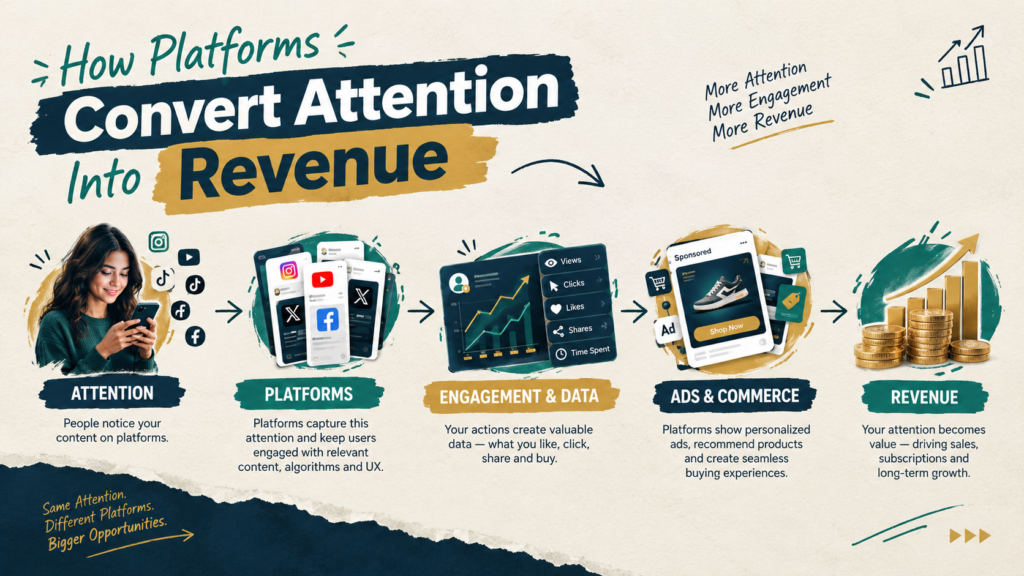
Meta provides a clear real-world example. In 2025, Meta reported $196.18 billion in advertising revenue, representing almost all of its total revenue of $200.97 billion. During the same year, ad impressions across its Family of Apps increased 12%, while the average price per ad increased 9%.
The mechanism is relatively simple: capture attention → increase engagement → deliver ads → measure responses → generate revenue. Marketers pay for impressions or actions such as clicks, meaning the commercial value of the platform depends heavily on its ability to connect advertisers with users.
This is why the Attention Economy is more than just a marketing concept. It explains a fundamental feature of today’s internet: platforms provide free or low-cost services, while businesses compete to access the attention of the people using them. And as digital content continues to multiply, the real scarcity is not information—it is human focus.
What Is Attention Economy and How Does It Work?
The Attention Economy describes a digital marketplace where human attention is treated as a scarce and valuable resource. We can consume an almost unlimited amount of content every day, but our ability to focus remains limited. That simple imbalance has created a powerful business model: platforms compete to capture our attention, keep us engaged, and create opportunities to monetize that engagement.
The scale of this market is difficult to ignore. According to DataReportal’s 2026 research, there were 5.79 billion active social media user identities worldwide in April 2026, equal to about 69.9% of the global population. The average active social media user also uses around 6.5 social platforms each month.
Attention Is a Limited Resource
Imagine having 100 unread notifications but only one free hour. You may have access to more information than ever before, but you cannot give everything equal attention. This is what makes attention economically valuable.
In the Attention Economy, platforms use design and technology to compete for those limited moments of focus. Personalized feeds, recommendations, autoplay, notifications, short-form videos, and infinite scrolling are all ways of reducing friction between one piece of content and the next. The objective is not necessarily to make every user stay forever, but to create an experience that repeatedly brings them back.
DataReportal estimates that users worldwide spend an average of 18 hours and 36 minutes per week using social media and online video feeds. Collectively, that amounts to more than 640 million years of content consumption every year.
Why Is User Attention Valuable to Businesses?
For businesses, attention creates an opportunity to reach potential customers. A person who notices a brand, watches a product video, clicks an advertisement, or visits a website has moved beyond simply being an anonymous viewer.
This is where the Attention Economy connects with digital advertising. Platforms can use engagement and other signals to make advertising more targeted and measurable. Meta, for example, reported $196.175 billion in advertising revenue in 2025, out of $200.966 billion in total revenue. Its Family of Apps also delivered 12% more ad impressions year over year, while its average price per ad increased by 9%.
How Does Attention Become Revenue?
The process can be simplified into a chain:
Attention → Engagement → Ad Exposure → User Action → Revenue
Platforms provide content and tools that attract users. More engagement creates more opportunities to display advertisements. Advertisers then pay based on impressions or actions such as clicks. Meta explicitly states that its advertising revenue comes from ads displayed across products such as Facebook, Instagram, and Messenger, with marketers paying based on impressions or user actions.
That is the core of the Attention Economy: the product is often free to the user, but the user’s time, engagement, and attention create commercial value. In a world overflowing with content, attention—not information—is the resource everyone is fighting to earn.
The Business Model Behind User Attention
The Attention Economy becomes easier to understand when you look at what happens behind a simple social media scroll. Platforms may offer their apps for free, but the business model depends on turning user activity into commercial value. Five connected elements play a major role: advertising, engagement, data collection, personalized content, and recommendation systems.
Advertising is often the most visible part of this model. Platforms create spaces where brands can reach users while they browse, watch, search, or interact. Meta reported $196.18 billion in advertising revenue in 2025, accounting for roughly 97.6% of its total revenue of $200.97 billion. Meta also reported that ad impressions across its Family of Apps increased 12% year over year, while the average price per ad increased 9%. These numbers show why attracting and retaining attention matters financially.
The second component is engagement. Likes, comments, shares, video views, clicks, and time spent on a platform all create signals about what users find interesting. More engagement can create more opportunities to serve advertising and can also help platforms improve their products. In the Attention Economy, even a few extra seconds of meaningful interaction can contribute to the larger commercial system.
Then comes data collection. Every interaction can provide behavioral information—such as the types of content someone watches, searches they make, or posts they engage with. This does not mean that every platform uses every piece of information in the same way; privacy practices and data policies vary. However, user activity can provide signals that help platforms understand audiences and improve ad targeting and content delivery. Google, for example, describes advertising technologies that use signals to help deliver relevant ads and measure advertiser performance.
Personalized content takes those signals a step further. Instead of showing identical feeds to everyone, platforms can tailor content based on interests and previous interactions. The goal is to make the experience more relevant, which can encourage continued use.
Finally, recommendation systems decide what content appears next. They help sort an enormous amount of available information into a feed that is more likely to attract each user’s interest. With 5.79 billion social media user identities worldwide in April 2026, according to DataReportal, the ability to organize content at this scale has become central to the modern internet.
Together, these elements form the engine of the Attention Economy: attract people, understand their interests, personalize their experience, encourage engagement, and create valuable opportunities for advertisers. What looks like a simple scroll on your screen is actually part of a sophisticated digital business model built around one scarce resource—human attention.
Social Media Attention Economy: Why Platforms Want You to Stay Longer
The Social Media Attention Economy refers to the business environment in which platforms compete to capture and retain people’s attention. Social media is no longer just a place to post photos or connect with friends; it has become a highly optimized environment where content, notifications, recommendations, and advertising are continuously designed around user engagement.
The scale explains why attention matters. DataReportal reports that there were 5.79 billion social media user identities worldwide in April 2026, while the typical active user visited 6.5 different social platforms each month. Users also spent an average of 18 hours and 36 minutes per week browsing social and video feeds. That represents an enormous amount of potential attention for platforms and advertisers to compete for.
How the Engagement-Focused Business Model Works
The Social Media Attention Economy largely operates through engagement. Every like, share, comment, click, video view, and interaction creates a signal about what users find interesting. Higher engagement can mean more time spent on the platform, which can create additional opportunities to display advertisements.
Meta’s financial results demonstrate the commercial importance of this model. In the second quarter of 2026, Meta reported 3.60 billion daily active people across its Family of Apps. During the same quarter, ad impressions increased 14% year over year, while the average price per ad increased 12%.
Why Likes, Shares, Comments, and Watch Time Matter
Engagement metrics help platforms understand how users respond to content. A video that receives strong watch time or repeated interactions can provide stronger signals than content that users immediately skip. These signals can then contribute to how content is ranked and recommended.
This is why creators often compete not simply for followers, but for attention and retention. A compelling opening hook, useful information, emotional storytelling, or entertaining format can encourage people to continue watching.
Infinite Scroll, Notifications, and Personalized Feeds
Infinite scrolling removes the natural stopping points that exist in traditional media. Instead of reaching the end of a page, users can continuously receive another post, Reel, Short, or video. Notifications add another layer by bringing users back when there is new activity.
Personalized feeds make this system even more powerful. Recommendation systems can continuously adjust the content shown to users based on their interactions and interests. In Meta’s filings, the company explains that its products use signals from user activity to improve content and advertising relevance.
Ultimately, the Social Media Attention Economy is built around a simple equation: more relevant content → more engagement → more opportunities for monetization. What feels like a casual five-minute scroll can therefore become part of a sophisticated digital system designed to make your next interaction feel worth continuing.
Attention Economy in Social Media: How Your Attention Becomes Revenue
The Attention Economy in Social Media follows a surprisingly simple business logic: platforms attract users, keep them engaged, learn from their interactions, and create opportunities for advertisers to reach them. You may not pay money every time you open Instagram, Facebook, or another social platform, but your attention has commercial value because advertisers are willing to pay to reach audiences.
To understand the Attention Economy in Social Media, start with the first step: attention. A user sees a Reel, watches a video, reads a post, or pauses on an advertisement. That moment creates an opportunity for the platform to deliver another piece of content or another advertisement. The longer and more meaningful the interaction, the more opportunities there may be to monetize that attention.
Why Do Advertisers Pay for Attention?
Advertisers are not simply paying for space on a screen. They are paying for the opportunity to put a message in front of a relevant audience. Social platforms can offer advertisers measurable outcomes such as impressions, clicks, video views, conversions, and other interactions.
This creates different ways of valuing attention. An impression generally means an advertisement was displayed. A click shows that someone took an additional action, while engagement can include interactions such as likes, comments, shares, or other responses. These metrics help advertisers evaluate whether their spending is reaching and influencing the intended audience.
The scale of this advertising market is substantial. DataReportal, citing Statista projections, estimated worldwide social media advertising expenditure at $277 billion in 2025, representing 13.6% year-on-year growth.
From Attention to Revenue
The monetization process can
The Role of Social Media Psychology in Capturing Attention
The Social Media Psychology behind today’s platforms is built around a simple human tendency: we naturally notice things that are surprising, emotionally meaningful, socially relevant, or potentially rewarding. In the Attention Economy, understanding these psychological triggers helps explain why one post can be ignored while another keeps us watching for several minutes.
One common mechanism is the curiosity gap. A headline such as “You’re making this mistake without realizing it” creates an information gap between what we know and what we want to know. The brain is given a reason to continue watching or clicking because the answer feels just out of reach. This technique is widely used in thumbnails, Reels, headlines, and short-form videos.
Then there is FOMO, or the fear of missing out. Social media constantly exposes users to other people’s experiences, updates, trends, and conversations. Research involving 21,473 participants across 33 independent samples found a positive association between FOMO and both social-networking-site use and problematic social-media use. A 2024 longitudinal study of 1,125 young adults aged 17–26 also examined different FOMO profiles and their relationship with social-media behaviour.
Social validation is another powerful trigger. Likes, comments, shares, followers, and views can function as visible signals of approval. Research on 411 young adults found that motives connected with social rewards—including social approval, social comparison, and FOMO—were particularly associated with frequent checking and problematic social-networking behaviour.
The idea of variable rewards makes the experience even more engaging. You never know whether the next notification will be an ordinary message, an interesting comment, or a post that unexpectedly entertains you. Research on reward-based motives has discussed how unpredictable rewards and continual reward anticipation can contribute to repeated checking behaviour.
Emotional content is equally important. Content that creates surprise, humor, excitement, anger, inspiration, or curiosity can stand out in a crowded feed because it gives users a stronger reason to pause and respond. This matters greatly in the Attention Economy, where thousands of pieces of content compete for the same few seconds of focus.
Finally, short-form content fits perfectly into this system. Quick videos deliver information or entertainment with very little commitment, making it easy to move from one piece of content to another. A 2025 study published in Nature Human Behaviour found that how people express themselves can significantly influence the attention they receive on social media, highlighting how attention is shaped by both users and content characteristics.
Together, curiosity, FOMO, social validation, variable rewards, emotional content, and short-form formats help explain the psychology powering modern social platforms. The result is a digital environment where capturing attention is not accidental—it is increasingly shaped by Social Media Psychology and the economics built around human focus.
Why Notifications Are So Powerful
Notifications look small, but within the Attention Economy, they can act as powerful tools for bringing users back to an app. A single vibration, sound, or pop-up can interrupt whatever someone is doing and create a simple question: “What happened?” That moment of curiosity can be enough to trigger another app session.
One reason notifications work is instant gratification. Social platforms can offer immediate social rewards through likes, comments, messages, mentions, and new followers. The reward does not always have to be guaranteed; simply knowing that something may be waiting on the other side of a notification can encourage a person to check. In a randomized trial involving 350 app users, receiving a notification increased the probability of opening the app within the following hour by 3.5 times compared with receiving no notification.
Notifications can also contribute to habit loops. A habit loop is often described through three stages: a cue, a routine, and a reward. The notification becomes the cue, opening the app becomes the routine, and whatever the user finds—an interesting post, message, or social interaction—can provide the reward. Repetition can make this sequence feel automatic. Interestingly, research involving real-world smartphone use found that many interactions were initiated by users themselves rather than notifications, suggesting that notifications may help strengthen an existing checking habit rather than completely control it.
Another important factor is fear of missing out (FOMO). A notification can suggest that something is happening without you. Maybe a friend posted something, a creator went live, or a trending conversation is moving quickly. Research published in 2024 found that social-media distractions can interfere with both global and local attention, while FOMO can influence the behavioral and neural response to those distractions.
This can lead to repeated checking behavior. The user may not consciously decide, “I need to check my phone again.” Instead, the repeated cue-response cycle can gradually become part of everyday behavior. A 2026 study found that social-media notifications produced a temporary slowdown in cognitive processing of approximately seven seconds, with stronger disruption associated with notification relevance and habitual smartphone interaction frequency.
This is why notifications matter so much in the Attention Economy. Their purpose is not always to provide essential information; they can also re-establish a connection between the user and the platform. More return visits create more opportunities for content consumption, engagement, and advertising.
Ultimately, the Attention Economy is built around a scarce resource: focus. Notifications are one of the simplest mechanisms for turning a quiet phone screen into another moment of digital engagement—and sometimes, another hour of scrolling.
User Attention on Social Media: How Algorithms Compete for Your Focus
User Attention on Social Media is not distributed randomly. Behind every personalized feed is a recommendation system designed to decide what content appears, in what order, and what a user is most likely to interact with. In the modern Attention Economy, these algorithms play a central role because platforms have to process an enormous volume of content while competing for limited human attention.
The Role of Recommendation Algorithms
Recommendation algorithms analyze signals from user behaviour to estimate which content may be relevant or interesting. TikTok, for example, says its recommendation system considers interactions such as videos users like or share, accounts they follow, comments they post, searches, and information contained in videos such as captions, sounds, and hashtags. It also gives greater weight to stronger indicators of interest, such as finishing a longer video.
YouTube follows a similar principle, using signals including clicks, watch time, likes, dislikes, sharing, and viewer-survey responses to help determine which videos may provide value to an individual user. YouTube says its recommendation system processes billions of pieces of information to personalize recommendations.
Personalized Feeds and Content Ranking
This creates a personalized feed rather than one universal timeline. Two people can open the same platform at the same moment and see completely different content. The algorithm continuously learns from interactions and adjusts future recommendations.
Content ranking is therefore a competition for relevance and engagement. A creator’s follower count alone does not guarantee distribution. TikTok has stated that follower count and previous high-performing videos are not direct factors in its For You recommendation system. Instead, the system evaluates combinations of user and content signals.
Why Watch Time and Engagement Matter
Watch time can be particularly valuable because it indicates whether a user continued consuming the content rather than abandoning it immediately. YouTube introduced watch time into its recommendation system after finding that clicks alone did not necessarily indicate that viewers found a video valuable. The platform later incorporated additional satisfaction signals, including surveys, likes, dislikes, and sharing.
This is an important feature of the Attention Economy: a click gets someone to start consuming, but sustained attention provides a deeper signal about the experience.
Why Emotionally Engaging Content Often Gets More Visibility
Emotion can make content easier to notice and remember. Research published in Nature Human Behaviour in 2025, using a large Generation Z dataset from China, found that the way people express emotions and use emojis was more influential in attracting social-media attention than several personal characteristics examined in the study. The researchers also found evidence that empathy-evoking expression contributed to attention attraction.
However, emotional content is not automatically rewarded on every platform. Recommendation systems differ, and platforms also apply quality, safety, and relevance controls.
Ultimately, User Attention on Social Media is shaped by a continuous feedback loop: your behaviour influences recommendations, recommendations influence what you watch, and your next interactions provide new signals. That feedback loop sits at the heart of the Attention Economy, where algorithms are effectively competing for the next few seconds of your focus.
Digital Attention: The New Currency of the Internet
Digital Attention is the amount of focus people give to online content, platforms, brands, videos, advertisements, and digital experiences. In simple terms, it is not just about how long someone stays online; it is about what captures their mind while they are there. A user can spend an hour online but give only a few seconds of meaningful attention to a particular brand. That difference has become extremely important in the modern Attention Economy.
The internet has changed the relationship between time and attention. Time tells us how long someone is present, while attention tells us whether they are actually noticing, watching, reading, remembering, or responding. For example, a person might scroll past 50 advertisements in ten minutes but remember only one. For the advertiser, that one meaningful interaction can be more valuable than hundreds of passive impressions.
Attention Scarcity in a Content-Heavy World
The biggest challenge today is not a lack of information. It is an excess of it. DataReportal estimates that 6.12 billion people were using the internet worldwide in April 2026, representing 73.8% of the global population. At the same time, there were around 5.79 billion social media user identities globally.
With billions of people producing and consuming content, every post, video, notification, and advertisement is competing against countless alternatives. This creates attention scarcity. A brand may have a valuable product, but that product still needs to earn enough attention to enter a customer’s consideration.
How Brands Acquire Digital Attention
Brands acquire Digital Attention by creating reasons for people to stop scrolling. Strong storytelling, useful educational content, entertaining videos, distinctive visuals, influencer partnerships, interactive experiences, and relevant personalization can all help a brand stand out.
The shift is also visible in advertising investment. The IAB/PwC Internet Advertising Revenue Report found that U.S. digital advertising revenue reached a record $294.6 billion in 2025, growing 13.9% year over year. The report highlights video, social, commerce media, and the creator economy as important parts of this expanding ecosystem.
Why Digital Attention Matters to the Digital Economy
The growing value of Digital Attention comes from its connection to measurable business outcomes. Attention can lead to engagement, brand awareness, website visits, product discovery, leads, and eventually purchases. That makes attention a bridge between consumers and the wider digital economy.
However, Digital Attention is not automatically valuable simply because it lasts longer. Ten seconds of genuine interest can sometimes matter more than ten minutes of distracted scrolling. This is why modern brands are increasingly focused on creating content that is not merely visible, but relevant, memorable, and worth paying attention to.
In the Attention Economy, the scarce resource is no longer access to information. Information is everywhere. The scarce resource is human focus—and brands, platforms, and creators are constantly competing to earn
Why Social Media Addiction Is Linked to Attention-Driven Design
The phrase Social Media Addiction is often used to describe a pattern where someone feels compelled to keep checking social platforms, finds it difficult to stop, or continues using them despite negative consequences. Researchers more often use terms such as problematic social media use because “addiction” is not a simple diagnosis that applies to everyone who spends a lot of time online. Still, research consistently shows associations between problematic social-media use and difficulties with self-regulation, attention, and everyday functioning. A 2025 meta-analysis covering 15 studies and 35,223 participants found a moderate positive association between problematic social media use and ADHD-related symptomatology, although this type of evidence does not establish that one directly causes the other.
One reason people can become stuck in repeated usage is habit-forming design. Many platforms reduce the small moments that would normally tell us to stop. Instead of reaching the end of a page, you can keep scrolling. Instead of choosing whether another video should start, autoplay begins it automatically. Instead of remembering to open an app, a notification can bring the app to you.
Infinite Scroll and Autoplay
Infinite scroll removes a natural stopping point. In a traditional magazine, reaching the final page creates a clear signal that the session is over. On social media, another post appears before you have time to decide whether you actually want to continue.
Autoplay works in a similar way. A video finishes and the next one begins almost immediately. This reduces the effort required to continue consuming content. The result can be surprisingly easy to recognize in everyday life: “I’ll watch one more” quietly becomes twenty more.
Push Notifications and Repeated Reward Cycles
Push notifications add an external trigger to the process. A message, like, comment, mention, or recommendation can interrupt another activity and create a reason to check the app. The reward is unpredictable—you may find something interesting, funny, socially rewarding, or completely unimportant. That uncertainty can make checking feel worth repeating.
This connects with the idea of repeated reward cycles. A user experiences a cue, opens the platform, receives some form of reward, and eventually encounters another cue. Over time, the sequence can become habitual. A 2024 systematic review and meta-analysis found that gratification-related motives were significantly associated with problematic internet use, supporting the idea that the rewards people seek online can play an important role in repeated use.
The important distinction is that Social Media Addiction is not simply about spending many hours online. Context, individual behaviour, and the consequences of that use matter. A 2025 systematic review also found that problematic social-media use was associated with inattention and impulsivity-related outcomes among adolescents, while noting that differences between studies make cause-and-effect conclusions difficult.
This is where the Attention Economy becomes relevant. Platforms have strong commercial incentives to create engaging experiences because sustained attention can generate more opportunities for content consumption, interaction, and advertising. The Attention Economy does not mean every design feature is intentionally created to make users “addicted”; rather, it describes an environment where keeping people engaged has significant economic value.
Ultimately, the link between Social Media Addiction and attention-driven design is best understood as a combination of human psychology, repeated habits, and platform mechanics. The more frictionless the experience becomes, the easier it is to continue—and sometimes, to lose track of why you opened the app in the first place.
Consumer Attention: Why Brands Are Fighting for SeconWhat Is Attention Economy and How Does It Work?
In a world where thousands of messages compete for our focus every day, Consumer Attention has become one of the most valuable resources for modern brands. A company can have a great product, an attractive website, and a strong offer, but none of that matters until people notice it. In the Attention Economy, the first challenge is no longer simply reaching consumers—it is earning enough attention to make them stop, understand, and respond.
Attention Span and Fragmented Audiences
Audiences are increasingly fragmented across social media, search engines, streaming platforms, messaging apps, podcasts, and creator channels. DataReportal reports that the typical global internet user spends around 18 hours and 36 minutes per week browsing social and video feeds. It also estimates that the average active social media user engages with 6.5 platforms each month.
This means brands are competing against not just other advertisements, but also entertainment, conversations, news, creators, and countless other distractions. A consumer may see a brand multiple times without remembering it. Therefore, Consumer Attention has to be meaningful, not merely measurable.
Traditional Advertising vs Digital Attention
Traditional advertising often relied on fixed placements such as television commercials, newspapers, billboards, and radio. Digital advertising introduced a much more interactive environment. A user can see an ad, click it, visit a website, watch a product demonstration, compare alternatives, and potentially purchase—all within the same journey.
The scale of this shift is substantial. According to the IAB/PwC 2025 Internet Advertising Revenue Report, U.S. digital advertising revenue reached a record $294.6 billion in 2025, growing 13.9% year over year. Social advertising alone generated $117.7 billion.
Brand Storytelling and Hook-Based Content
Strong brand storytelling gives people a reason to care rather than simply telling them what a product does. Instead of starting with a sales message, brands can begin with a problem, emotion, transformation, or relatable situation.
Then comes hook-based content. A strong opening line, visual, question, or unexpected statement can determine whether someone keeps watching or scrolls away. The objective is not to manipulate attention, but to make the content relevant enough to deserve it.
Personalization and Conversion
Personalization can make that attention more relevant by matching content, offers, and messaging with audience interests or behaviour. The next step is turning attention into action: attention → engagement → interest → consideration → conversion.
Creator marketing provides one example of this shift. IAB projected U.S. creator advertising spending at $37 billion in 2025, up 26% year over year, with nearly half of creator ad buyers considering creators a “must buy” channel.
Ultimately, Consumer Attention is valuable when it moves beyond a fleeting view. When the right message reaches the right person, creates genuine interest, and makes the next action easy, attention can become a business result. That is the real competitive battleground of the Attention Economy: not simply being seen, but being worth noticing.
Attention as a limited resource
Consumer Attention is limited, even though the amount of content available to us continues to grow. Every day, people move between social media, search engines, streaming platforms, messaging apps, websites, advertisements, and creator content. There are only so many hours in a day and only a limited amount of mental focus available. This imbalance is at the heart of the Attention Economy: when content supply keeps increasing but human attention does not, attention becomes a scarce resource that brands must compete to earn.
The scale of this competition is enormous. DataReportal reports that the typical internet user spends approximately 18 hours and 36 minutes per week using social media and online video feeds. It also estimates that the world spends more than 15 billion hours every day consuming content on social platforms.
Attention Span and Fragmented Audiences
It is tempting to say that people’s attention spans are simply becoming shorter, but the reality is more nuanced. Audiences are increasingly fragmented across multiple platforms and formats. Someone might discover a brand through an Instagram Reel, research it on Google, watch a YouTube review, and finally purchase through a website or marketplace.
This makes Consumer Attention harder to capture consistently. A brand is not competing only with another advertisement; it is competing with entertainment, conversations, news, notifications, and everything else demanding attention at that moment.
Traditional Advertising vs. Digital Attention
Traditional advertising generally depended on fixed placements such as television, radio, newspapers, and billboards. Digital media introduced a more interactive environment where users can immediately click, search, comment, share, or purchase.
The commercial importance of this shift is clear. U.S. digital advertising revenue reached $294.6 billion in 2025, up 13.9% year over year, while social advertising alone generated $117.7 billion, growing 32.6%.
Brand Storytelling, Hooks, and Personalization
In the Attention Economy, brands increasingly use storytelling to make messages memorable rather than simply presenting product features. A strong story creates context and emotion, while hook-based content gives people a reason to stop scrolling. The first few seconds of a video, the opening sentence of an article, or a striking visual can determine whether someone continues or moves on.
Personalization adds another layer by making content more relevant to individual interests and behaviours. Recommendation and advertising systems can use available signals to deliver different messages to different audiences.
Turning Attention Into Conversion
Capturing attention is only the beginning. Brands need to move people from attention → interest → consideration → action. That might mean watching a product demonstration, visiting a landing page, signing up for a newsletter, requesting a quote, or making a purchase.
This is why valuable Consumer Attention is not necessarily the attention that lasts longest. It is the attention that is relevant enough to create understanding and meaningful action. In an increasingly crowded digital marketplace, earning that kind of attention is becoming one of the most important challenges for modern businesses.
How Brands Win Attention Without Feeling Like Advertising
In the modern Attention Economy, people are exposed to an enormous amount of content every day. The challenge for brands is no longer simply getting an advertisement in front of someone; it is making that message feel relevant enough to deserve attention. This is why some of the most effective campaigns do not look like traditional advertisements at all. They tell stories, entertain, educate, or become part of the conversations people are already having.
Storytelling
Storytelling gives a brand something beyond a product to talk about. Instead of saying, “Our product is better,” a brand can show a problem, a journey, a transformation, or a human experience. Stories create context and make commercial messages easier to remember. In the Attention Economy, this matters because people are more likely to stay with content when there is a reason to care about what happens next.
Native Content
Native content is designed to fit naturally into the platform where people are consuming it. A useful LinkedIn post, an entertaining Instagram Reel, or an informative YouTube video can feel less disruptive than a conventional advertisement. The objective
The Dark Side of the Attention Economy
The Attention Economy has created a powerful digital ecosystem where platforms, creators, and brands compete for limited human focus. While this system can make content more relevant and entertaining, it also has a less comfortable side. When engagement becomes a major business objective, the features that keep people interested can sometimes contribute to information overload, compulsive scrolling, distraction, misinformation, and privacy concerns.
Information Overload
The internet gives people access to more content than they could realistically consume. News updates, Reels, notifications, advertisements, messages, and recommendations can arrive continuously throughout the day. The problem is not simply the amount of information but the difficulty of deciding what deserves attention. When everything appears urgent or interesting, users can become mentally overloaded and struggle to focus on one task.
Doomscrolling and Reduced Focus
Doomscrolling describes repeatedly consuming negative, distressing, or alarming content, often for longer than intended. A 2025 longitudinal study of 301 adolescents aged 12–19 found significant positive relationships between social-media addiction and doomscrolling across two measurement periods. The study establishes an association, not proof that one automatically causes the other.
Research also suggests a relationship between problematic social-media use and attention-related difficulties. A 2025 meta-analysis covering 15 studies and 35,223 participants found a moderate positive correlation between problematic social-media use and ADHD-related symptomatology (r = 0.361). Because much of this evidence is correlational, it should not be interpreted as proof that social media directly causes attention disorders.
Misinformation and the Race for Engagement
Another concern is misinformation. Content designed to trigger surprise, anger, fear, or curiosity may attract more immediate attention than carefully qualified information. Research published in 2025 involving 1,319 participants in China found that people distinguished less between true and false information when deciding whether to share content than when explicitly asked to evaluate its accuracy. The researchers estimated that inattention-based processes could explain more than 37% of COVID-19 misinformation sharing in their Chinese sample.
Manipulative Design and Privacy Concerns
Some digital experiences also use design techniques that can steer users toward particular actions. The FTC and international consumer-protection groups reviewed 642 websites and mobile apps in 2024 and found that nearly 76% used at least one possible “dark pattern,” such as design that could influence purchasing or privacy decisions. This review did not determine that every identified practice was unlawful.
Privacy is another important issue. Pew Research Center found that 48% of U.S. adults considered it unacceptable for social-media companies to analyze users’ activity to deliver personalized content, while 77% said they had little or no trust in social-media leaders to publicly acknowledge mistakes and take responsibility for data misuse.
The Attention Economy is therefore not inherently harmful, but its incentives deserve scrutiny. When attention becomes a commercial resource, the important question is not only how much content we consume, but how that content affects our focus, choices, information environment, and privacy. Understanding these trade-offs is the first step toward using digital platforms more consciously.
How to Protect Your Attention in a Digital World
In the Attention Economy, your attention is constantly being invited, interrupted, and redirected. Social media platforms are built to make content easy to access, while notifications, recommendations, and endless feeds make it equally easy to keep consuming. The answer is not necessarily to leave the internet completely. A more practical approach is to become intentional about where your attention goes.
Manage Notifications
Start with notification management. Not every alert deserves immediate attention. Turn off non-essential notifications, particularly promotional alerts and social-media updates that do not require a quick response. Keeping only important alerts visible reduces unnecessary interruptions and gives you more control over when you check an app instead of letting the app decide for you.
Set Screen-Time Boundaries
Screen-time boundaries can make digital habits more deliberate. Set specific periods for social media rather than opening an app whenever you feel bored. Phone-based screen-time tools can help you identify which apps consume the most time and establish daily limits. The objective is not to create a perfect number of screen-free hours, but to prevent unplanned scrolling from taking over activities that matter more.
Practice Intentional Scrolling
Before opening an app, ask yourself a simple question: “Why am I opening this?” You might want to reply to a message, learn something, publish content, or check a specific update. Once that purpose is complete, close the app. This small habit turns passive consumption into intentional scrolling.
Curate Your Feed
Your feed influences what repeatedly receives your attention. Unfollow accounts that consistently distract you, mute irrelevant topics, and actively follow creators who provide useful, educational, or inspiring content. In the Attention Economy, curating your feed is essentially deciding which voices are allowed to compete for your limited focus.
Try a Digital Detox—But Be Practical
A digital detox does not necessarily mean abandoning every device for a week. It can mean taking a planned break from particular platforms or reducing unnecessary digital activity. Evidence is mixed but encouraging in some areas. A 2024 systematic review and meta-analysis covering 26 studies and 8,147 participants found that digital detox interventions produced small improvements in subjective and psychological well-being. However, a 2025 meta-analysis of 10 studies involving 4,674 participants found that temporary social-media abstinence did not significantly improve positive affect, negative affect, or life satisfaction. This suggests that reducing problematic or unnecessary use may be more useful than treating complete abstinence as a universal solution.
Make Room for Long-Form Reading and Focused Work
Finally, deliberately spend some time on activities that require sustained concentration: reading a long article, studying, writing, learning a skill, or completing focused work without checking your phone. These activities create a different relationship with attention because they reward staying with one task rather than constantly switching between stimuli.
Protecting your attention is ultimately about choice. The Attention Economy will continue competing for your focus, but you can decide what deserves it. Your goal is not to eliminate digital media—it is to make sure your attention is being spent on things you actually value.
The Future of the Attention Economy in the Age of AI
Artificial intelligence is changing the Attention Economy in one fundamental way: it is making content faster and cheaper to produce. A few years ago, creating a high-quality video, image, article, or advertisement required considerable time, money, and specialist skills. Today, generative AI can help produce multiple versions in minutes. That sounds like a major advantage for businesses—but it also creates a new problem: when everyone can produce more content, getting someone to notice your content becomes harder.
AI-Generated Content and Increasing Competition
The growth is already visible. A 2025 Ahrefs survey of 879 marketers found that 87% use AI to help create content, while its research found that marketers using AI published 42% more content than those not using it.
IDC research sponsored by Seagate found that 66% of organizations reported an increase in the total number of content files they create after adopting generative AI, with 27.5% describing the increase as significant.
This creates a clear challenge for the Attention Economy: content becomes abundant, but human attention remains limited.
Hyper-Personalization and AI Recommendation Systems
AI is also making feeds more personalized. Recommendation systems can analyze signals such as previous interactions and use machine learning to decide which content should appear in a user’s feed. The OECD describes these systems as effectively acting like a personalized editor, selecting what individual users see based on their engagement patterns.
In the future, personalization could become even more precise. Platforms may increasingly adapt content, advertisements, recommendations, and timing to individual preferences and behaviour. For users, that can create more relevant experiences; for platforms and advertisers, it can create more opportunities to capture attention.
Synthetic Media and the Fight for Trust
AI is not only generating ordinary marketing content. It is also making synthetic images, videos, voices, and deepfakes easier to create. Deloitte reported that deepfake content on social media increased 550% between 2019 and 2023. Full Fact has also reported an increase in manipulated synthetic AI content and warned that realistic AI-generated material can gradually weaken trust in online information.
That means the future battle may not simply be about producing content—it may be about producing content people trust.
Why Human Attention May Become Even More Valuable
As AI expands the amount of content available, the supply of information can grow far faster than people’s ability to consume it. This makes genuine human attention increasingly scarce. A beautifully generated advertisement may take seconds to create, but earning someone’s curiosity, trust, and sustained interest still requires relevance and creativity.
The future Attention Economy will therefore be shaped by a paradox: AI can create almost unlimited content, but it cannot create unlimited human attention. Brands that succeed will likely be those that combine AI’s scale and speed with human storytelling, originality, credibility, and a clear understanding of what audie
Conclusion: Your Attention Is Valuable
The Attention Economy has changed the way we understand the internet. What looks like a simple scroll through Instagram, a YouTube video, or a notification on your phone is part of a much larger digital system built around one scarce resource: human attention. Platforms compete to capture that attention, algorithms determine what appears in front of us, and advertisers pay for opportunities to reach engaged audiences.
The scale of social media shows just how valuable this resource has become. DataReportal reported approximately 5.79 billion active social media user identities worldwide in April 2026, while the average active user used around 6.5 social platforms each month. It also estimated that people spend about 18 hours and 36 minutes per week consuming social and video feeds.
This creates a clear business connection between psychology, algorithms, and advertising. Social Media Psychology helps explain why curiosity, emotional content, FOMO, social validation, and unpredictable rewards can capture attention. Recommendation algorithms then use behavioural signals such as watch time, clicks, likes, and shares to personalize what people see. Finally, advertising systems turn that engagement into measurable commercial opportunities.
Meta provides a useful example of the business value involved. In 2025, the company generated $196.18 billion in advertising revenue, compared with approximately $200.97 billion in total revenue. Its Family of Apps also delivered 12% more ad impressions year over year.
But understanding the Attention Economy is not about becoming afraid of technology. It is about becoming more conscious of how digital environments compete for your focus. Managing notifications, setting screen-time boundaries, curating your feeds, and making room for focused activities can help you decide where your attention goes instead of reacting automatically to every digital signal.
The future will make this even more important. Artificial intelligence is making content creation faster and more abundant, while personalized recommendation systems are becoming increasingly sophisticated. When millions of new pieces of content can be generated quickly, human attention becomes even scarcer.
That is the central lesson of the Attention Economy: your attention is not an unlimited resource, and every minute you give to a platform has an opportunity cost. Businesses will continue trying to earn it, algorithms will continue trying to predict it, and AI will create more competition for it. The most valuable skill may therefore be knowing not only how to capture attention, but how to control your own.