
Digital marketing has become one of the most important ways for businesses to attract customers, generate leads, build brand awareness, and increase sales. However, simply being active on social media, publishing blog posts, running Google Ads, or investing in SEO does not guarantee results. Many businesses spend significant time and money on digital marketing but still struggle to generate website traffic, qualified leads, conversions, and a positive return on investment. The reason is often not a lack of effort, but the presence of common digital marketing mistakes.
One of the biggest reasons digital marketing campaigns fail is the absence of a clear and measurable digital marketing strategy. Businesses often start marketing activities without defining their target audience, business objectives, customer journey, or key performance indicators (KPIs). As a result, their SEO, social media marketing, content marketing, and paid advertising efforts work independently instead of supporting the same business goal. A successful digital marketing strategy connects every marketing channel and focuses on moving potential customers from awareness to consideration and finally to conversion.
Another common problem is targeting the wrong audience. Even excellent content, attractive social media posts, and well-designed advertisements cannot deliver strong results if they reach people who are unlikely to become customers. Understanding the target audience, buyer persona, search intent, pain points, interests, and purchasing behavior is essential for effective digital marketing and lead generation.
Businesses can also lose potential customers because of poor SEO, irrelevant content, weak landing pages, ineffective calls-to-action, or poorly optimized advertising campaigns. For example, a website may receive traffic through search engines but generate very few leads because the content does not match user intent or the landing page does not provide a clear next step. Similarly, social media accounts may receive likes and followers without generating meaningful sales. These are signs that marketing activity is taking place, but the overall digital marketing strategy is not optimized for conversions.
Another major issue is the failure to track and analyze performance. Without monitoring website traffic, conversion rates, keyword rankings, cost per lead, click-through rates, and digital marketing ROI, businesses cannot accurately identify what is working and what needs improvement. Data-driven decision-making is essential for optimizing SEO, Google Ads, Meta Ads, social media marketing, and content marketing campaigns.
The good news is that most digital marketing mistakes can be identified and fixed. By creating a clear digital marketing strategy, understanding the target audience, improving SEO, producing valuable content, optimizing advertising campaigns, and continuously analyzing performance, businesses can turn ineffective marketing efforts into measurable growth.
In this guide, we will explore 9 common digital marketing mistakes that can negatively affect traffic, leads, conversions, and sales—and, more importantly, how you can fix them.
What Are the Biggest Digital Marketing Mistakes?

Many businesses ask the same question: “Why is my digital marketing not working?” They may be posting regularly on social media, publishing content, investing in SEO, running Google Ads, or trying different marketing campaigns, yet the expected traffic, leads, conversions, and sales are not coming. In most cases, the problem is not digital marketing itself but the way the digital marketing strategy is planned, executed, and measured.
One of the biggest digital marketing mistakes is confusing marketing activity with actual marketing results. Posting five times a week, gaining followers, receiving likes, increasing website visits, or sending emails may look productive, but these activities do not automatically generate business growth. A successful digital marketing campaign should ultimately contribute to meaningful outcomes such as qualified leads, conversions, customer acquisition, revenue, and improved digital marketing ROI. Businesses need to focus not only on how much marketing they are doing but also on what those activities are actually achieving.
For example, a company may receive thousands of visitors through SEO but generate very few enquiries. Another business may have thousands of social media followers but almost no sales. Similarly, a Google Ads campaign may generate hundreds of clicks while producing very few qualified leads. These situations indicate that marketing activity exists, but the overall digital marketing strategy may not be aligned with business objectives or customer intent.
Poor planning is another major reason why digital marketing is not working. Without clearly defined goals, target audiences, buyer personas, marketing channels, budgets, content plans, and performance metrics, businesses often make decisions based on assumptions. This can result in wasted advertising budgets, irrelevant content, ineffective SEO campaigns, poor audience targeting, and low conversion rates.
A strong digital marketing strategy should begin with clear objectives. Businesses should determine whether they want to increase brand awareness, generate leads, drive website traffic, increase online sales, improve customer retention, or achieve a combination of these goals. Once the objectives are clear, marketers can select the right combination of SEO, social media marketing, content marketing, email marketing, Google Ads, Meta Ads, and other digital marketing channels.
Tracking the right metrics is equally important. Website traffic alone does not tell the complete story. Businesses should monitor conversion rate, qualified leads, cost per lead, customer acquisition cost, click-through rate, engagement, keyword rankings, sales, and digital marketing ROI. These metrics help identify which campaigns are producing results and where optimization is required.
Ultimately, effective digital marketing is not about doing more—it is about doing the right things with a clear strategy. By identifying common digital marketing mistakes, setting measurable goals, understanding the target audience, and continuously analyzing performance, businesses can transform marketing activity into measurable and sustainable results.
Mistake #1: Starting Without a Clear Digital Marketing Strategy

One of the most common digital marketing mistakes businesses make is starting marketing activities without a clear digital marketing strategy. Many businesses create social media posts, publish blogs, run Google Ads, invest in SEO, or launch Meta Ads simply because competitors are doing the same. However, without a defined direction, these activities can become disconnected efforts that consume time and budget without producing consistent traffic, qualified leads, conversions, or sales.
A strong digital marketing strategy provides a roadmap for achieving specific business objectives through online marketing channels. It helps businesses understand who they want to reach, what they want to achieve, which channels they should use, what type of content they need, and how success will be measured. Without this strategic foundation, even well-executed SEO, social media marketing, content marketing, and paid advertising campaigns can struggle to deliver a positive digital marketing ROI.
The first step is setting measurable marketing goals. Instead of using vague objectives such as “increase online presence” or “get more followers,” businesses should establish specific and measurable goals. These could include increasing organic website traffic by a certain percentage, generating a specific number of qualified leads, improving conversion rates, increasing online sales, reducing cost per lead, or achieving a particular return on advertising spend. Clear goals make it easier to evaluate whether a digital marketing campaign is actually working.
Another important part of a successful strategy is connecting different marketing channels. SEO can attract users through organic search, while content marketing can educate and build trust with those users. Social media marketing can increase brand awareness and engagement, while Google Ads and Meta Ads can reach high-intent audiences and generate faster traffic and leads. When these channels work together, they create a stronger customer journey instead of operating as separate marketing activities.
Building a goal-based digital marketing strategy also requires understanding the target audience. Businesses should identify their buyer persona, customer pain points, interests, search behavior, purchasing intent, and preferred communication channels. This information helps marketers create relevant content, select appropriate keywords, design better advertisements, and develop more effective lead-generation campaigns.
The next step is creating a practical marketing plan. Define the business objective first, identify the target audience, select the most relevant digital marketing channels, create a content and advertising plan, establish a realistic budget, and determine the key performance indicators (KPIs). These KPIs may include organic traffic, keyword rankings, engagement rate, click-through rate, leads, conversions, customer acquisition cost, and digital marketing ROI.
Finally, a digital marketing strategy should never remain static. Regular performance analysis is essential to identify what is working and what needs improvement. By testing campaigns, analyzing data, optimizing content, and adjusting budgets, businesses can continuously improve their marketing performance.
A clear, measurable, and goal-based digital marketing strategy turns random online activities into a coordinated growth system. Instead of simply being active online, businesses can focus their resources on activities that generate meaningful and measurable business results.
Mistake #2: Targeting the Wrong Audience

One of the most costly digital marketing mistakes is targeting the wrong audience. A business can have an excellent product, attractive website, valuable content, and a strong digital marketing strategy, but if its marketing messages are reaching people who are unlikely to become customers, the campaign will struggle to generate meaningful results. Understanding your target audience is therefore essential for increasing website traffic, engagement, qualified leads, conversions, and overall digital marketing ROI.
Before creating any marketing campaign, businesses need to understand who their ideal customers are. This includes their age, location, profession, interests, purchasing behavior, problems, goals, budget, and preferred platforms. A clear understanding of the target audience helps marketers create relevant content and deliver the right message to the right people at the right stage of the customer journey.
Creating an accurate buyer persona is one of the best ways to understand your potential customers. A buyer persona is a semi-fictional representation of an ideal customer based on market research, customer data, existing buyers, and audience behavior. It should include information such as customer demographics, pain points, goals, challenges, buying motivations, objections, online behavior, and preferred communication channels. The more accurately a business understands its buyer persona, the easier it becomes to create effective content marketing, social media marketing, SEO, and paid advertising campaigns.
Customer needs are another important part of effective audience targeting. People do not search online simply because they want to see advertisements; they search because they have a question, problem, need, or specific goal. Understanding these needs allows businesses to create content that provides genuine value. For example, someone searching for “best digital marketing strategy for small business” has a different level of intent from someone searching for “digital marketing agency pricing.” Recognizing this difference can help businesses create content and offers that match the user’s expectations.
Search intent is particularly important for SEO and content marketing. Users may have informational, navigational, commercial, or transactional intent. If a business creates content without considering search intent, it may attract visitors who are not ready or interested in taking the desired action. Matching keywords, content, landing pages, and offers with search intent can improve the quality of organic traffic and increase conversion opportunities.
Audience targeting is also extremely important in Google Ads and Meta Ads. Instead of showing advertisements to everyone, businesses can use demographics, interests, locations, behaviors, keywords, remarketing audiences, and other targeting options to reach more relevant prospects. Better targeting can reduce wasted advertising spend and improve click-through rates, conversion rates, and lead generation.
Ultimately, effective audience targeting is not about reaching the largest possible number of people. It is about reaching the right people who are most likely to need, trust, and purchase your product or service. By understanding the target audience, developing accurate buyer personas, analyzing customer needs and search intent, and continuously optimizing audience segments, businesses can create more relevant marketing campaigns and generate higher-quality leads.
A well-defined audience gives every part of your digital marketing strategy a clear direction—from SEO keywords and content creation to social media campaigns, Google Ads, Meta Ads, landing pages, and lead generation efforts.
Mistake #3: Ignoring SEO and Search Intent
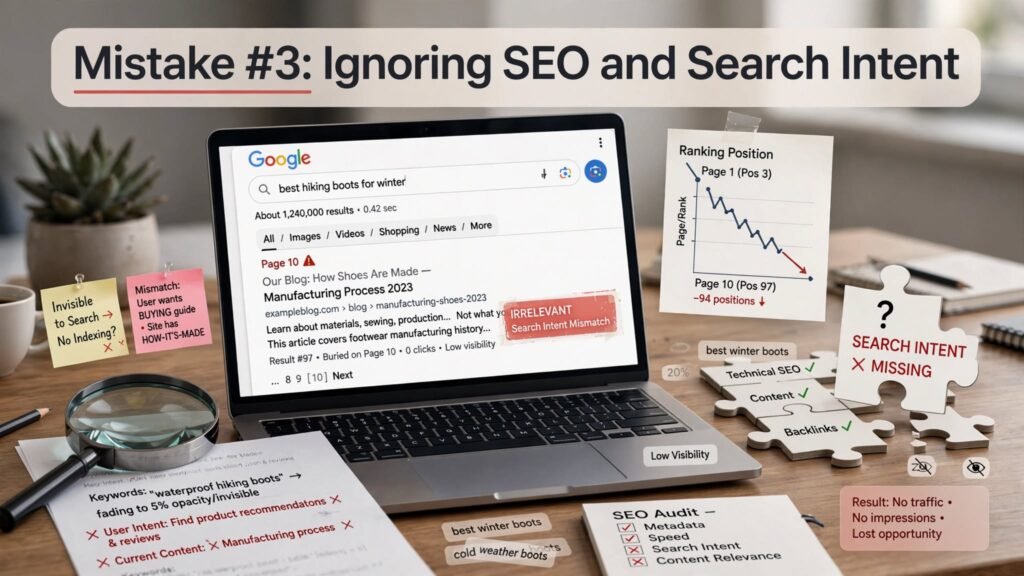
Ignoring SEO is one of the most serious digital marketing mistakes a business can make. In a competitive online environment, having a website is not enough. Your potential customers need to be able to discover your website when they search for products, services, answers, or solutions related to your business. A well-planned SEO strategy helps improve search engine visibility, attract relevant visitors, build online authority, and generate consistent organic traffic over the long term.
Unlike paid advertising, where traffic generally stops when the advertising budget stops, effective SEO can continue attracting users through search engines over an extended period. However, many businesses make common SEO mistakes that prevent their websites from reaching their full potential. These mistakes include targeting irrelevant keywords, ignoring search intent, publishing low-quality content, using duplicate content, neglecting technical SEO, having poorly optimized pages, and failing to optimize websites for mobile users.
One of the most important parts of successful SEO is keyword research. Businesses need to identify the words and phrases their target audience actually uses when searching online. However, simply choosing keywords with high search volume is not enough. Marketers must also understand search intent—the reason behind a user’s search. Search intent can generally be informational, navigational, commercial, or transactional. Creating content that matches the user’s intent increases the chances of attracting relevant visitors and moving them toward conversion.
For example, someone searching for “what is SEO” is likely looking for educational information, while someone searching for “SEO agency pricing” may be comparing services. A user searching for “hire SEO agency” has a much stronger transactional intent. Understanding these differences allows businesses to create the right content for different stages of the customer journey.
On-page SEO is another essential part of an effective SEO strategy. It includes optimizing page titles, meta descriptions, headings, URLs, content, internal links, images, and relevant keywords. High-quality, useful content should answer the user’s query clearly while naturally incorporating important keywords and related topics.
Technical SEO focuses on the technical performance and accessibility of a website. Website speed, mobile responsiveness, crawlability, indexability, XML sitemaps, structured data, broken links, and secure HTTPS connections can all influence how effectively search engines discover and understand a website. Ignoring technical SEO can limit the visibility of even excellent content.
For businesses serving specific geographic areas, local SEO is equally important. Optimizing Google Business Profile information, local keywords, business details, reviews, location pages, and citations can help businesses appear in relevant local searches and attract customers nearby.
When keyword research, search intent, on-page SEO, technical SEO, and local SEO work together, businesses can build a stronger search presence. A well-optimized website can attract users who are actively searching for relevant information, products, or services, making organic traffic more valuable and sustainable.
Ultimately, SEO is not simply about ranking higher on Google. It is about connecting the right audience with the right content at the right moment. By avoiding common SEO mistakes and building a search-intent-focused SEO strategy, businesses can increase organic visibility, attract qualified traffic, support lead generation, and achieve stronger long-term digital marketing growth.
Mistake #4: Creating Content Without a Clear Purpose

Creating content consistently does not automatically mean your content marketing strategy is working. One of the most common digital marketing mistakes businesses make is publishing random content without a clear purpose, target audience, or measurable goal. Posting blogs, social media updates, videos, reels, or promotional messages simply to remain active can consume significant time and resources without generating meaningful website traffic, qualified leads, conversions, or sales.
Effective content marketing starts with a simple question: What should this content achieve? Every piece of content should have a specific purpose connected to a broader digital marketing strategy. Depending on the business objective, content may be designed to increase brand awareness, attract organic traffic, educate potential customers, build trust, generate leads, support sales, or encourage existing customers to take further action.
Random content often fails because it focuses more on what the business wants to say than what the customer actually needs to know. Instead of creating content based on assumptions, businesses should identify their customers’ problems, questions, challenges, interests, and search behavior. Understanding these customer pain points allows marketers to create useful content that solves real problems and provides genuine value.
A strong content marketing strategy should also define clear content goals. For example, a business may use SEO-focused blog posts to increase organic traffic, educational videos to build authority, social media content to increase engagement, case studies to build trust, and product-focused landing pages to generate conversions. When every content format has a specific role, content becomes part of a coordinated marketing funnel rather than a collection of unrelated posts.
Different types of content can support different stages of the customer journey. Educational content is useful for people who are still researching a problem or looking for information. Blog posts, guides, tutorials, how-to articles, and informational videos can help attract these users through SEO and establish the brand as a useful source of information.
Commercial content targets people who are evaluating different solutions. Comparison articles, service pages, case studies, reviews, and product-focused content can help potential customers understand why a particular solution may be suitable for them. This type of content can bridge the gap between awareness and purchase consideration.
Conversion-focused content is designed to encourage a specific action. Landing pages, service pages, lead magnets, free consultations, demos, contact forms, and strong calls-to-action can help turn interested visitors into leads and customers. The goal is not simply to generate views but to create a clear path from content consumption to meaningful action.
Businesses should also measure content performance using relevant metrics. Depending on the goal, these may include organic traffic, engagement rate, time on page, keyword rankings, click-through rate, leads, conversion rate, and revenue generated from content.
Ultimately, successful content marketing is not about publishing more content—it is about publishing the right content for the right audience at the right stage of the customer journey. By creating content around customer problems, defining clear content goals, and connecting educational, commercial, and conversion-focused content, businesses can transform their content strategy from random activity into a powerful system for generating qualified leads and customers.
Mistake #5: Focusing on Followers Instead of Conversions

One of the most common social media marketing mistakes businesses make is treating followers, likes, and comments as the primary indicators of success. While a large social media following can increase brand visibility and awareness, followers alone do not guarantee business growth. A business can have thousands of followers and still generate very few leads or sales. Effective digital marketing focuses on turning audience attention into meaningful business results such as qualified leads, conversions, customers, and revenue.
Likes and followers are useful engagement signals, but they should not be confused with actual marketing outcomes. For example, a post may receive thousands of likes because it is entertaining or visually attractive, but if it generates no website visits, enquiries, leads, or purchases, its direct business impact may be limited. This is why businesses need to understand the difference between engagement, leads, and sales.
Engagement measures how people interact with your content through likes, comments, shares, saves, clicks, and views. Leads represent people who have shown meaningful interest in your product or service, such as submitting a form, requesting a quotation, booking a consultation, or contacting the business. Sales go one step further by converting interested prospects into paying customers. A successful social media marketing strategy should create a pathway from awareness and engagement to lead generation and ultimately sales.
Another important digital marketing mistake is creating social media content without a conversion objective. Instead of publishing content simply to stay active, businesses should create conversion-focused social media campaigns with a clear purpose. Depending on the campaign goal, this could include driving users to a website, generating WhatsApp enquiries, collecting lead-form submissions, promoting a product, booking appointments, or encouraging users to request more information.
Strong calls-to-action (CTAs) are essential for moving users from engagement to action. Phrases such as “Get a Free Consultation,” “Request a Quote,” “Learn More,” “Book Now,” or “Contact Us” can provide users with a clear next step. The CTA should also lead to a relevant landing page, contact form, product page, or other conversion-focused destination.
Businesses should also measure meaningful social media results instead of focusing only on vanity metrics. Important metrics can include website clicks, qualified leads, conversion rate, cost per lead, customer acquisition cost, revenue generated, and return on advertising spend. These metrics provide a clearer picture of whether social media marketing is contributing to overall digital marketing ROI.
Organic social media and paid advertising can also work together. Organic content can build trust and brand awareness, while Meta Ads and other paid campaigns can reach specific audience segments and drive targeted traffic or leads. Retargeting can further help reconnect with users who previously interacted with the brand but did not convert.
The goal of social media marketing is not simply to collect followers—it is to build relationships with the right audience and guide them toward meaningful action. By moving the focus from likes and followers to engagement, lead generation, conversions, and sales, businesses can create a more effective social media strategy and turn social platforms into a measurable growth channel.
Mistake #6: Running Google Ads and Meta Ads Without Proper Tracking

Paid advertising can generate traffic, leads, and sales quickly, but running Google Ads and Meta Ads without proper tracking is one of the most expensive digital marketing mistakes a business can make. Many businesses focus on impressions, clicks, or the amount of money spent on advertising without knowing whether their campaigns are actually generating qualified leads, customers, or revenue. Without accurate tracking, it becomes difficult to understand what is working, what is wasting budget, and how to improve digital marketing ROI.
One of the most common Google Ads mistakes is optimizing campaigns only for clicks instead of meaningful conversions. A high number of clicks may look positive, but clicks do not automatically mean sales or leads. Businesses should track actions such as form submissions, phone calls, purchases, bookings, downloads, or other valuable actions. Poor keyword selection, broad targeting, irrelevant search terms, weak ad copy, and poorly optimized landing pages can also increase advertising costs without producing quality results.
Similarly, common Meta Ads mistakes include targeting an overly broad or irrelevant audience, using weak creative, optimizing for the wrong campaign objective, failing to test different audiences, and not using retargeting effectively. A campaign may generate thousands of impressions and significant engagement while producing very few qualified leads. Meta Ads should therefore be evaluated according to the actual business objective rather than surface-level engagement metrics.
This is where conversion tracking becomes essential. Conversion tracking connects advertising activity with actual business outcomes. It helps marketers understand which campaigns, ad groups, keywords, audiences, ads, and landing pages are generating valuable actions. For example, if one Google Ads campaign generates 100 clicks but only two leads while another generates 60 clicks and 15 leads, the second campaign may be significantly more valuable even though it receives less traffic.
Several key metrics help businesses evaluate paid advertising performance. CPC (Cost Per Click) shows how much is being paid for each click. CTR (Click-Through Rate) measures the percentage of people who click an advertisement after seeing it. CPA (Cost Per Acquisition) indicates how much it costs to generate a conversion or acquisition. ROAS (Return on Ad Spend) measures the revenue generated in relation to advertising expenditure. Together, these metrics provide a clearer understanding of campaign efficiency.
However, these metrics should always be interpreted according to the campaign objective. A low CPC does not necessarily mean a campaign is successful if the traffic does not convert. Likewise, a higher CPA may still be acceptable if the customers generated by the campaign have a high lifetime value. The ultimate goal is to understand the relationship between advertising spend, conversions, revenue, and profitability.
Proper tracking also enables continuous digital marketing optimization. Marketers can identify high-performing keywords and audiences, pause underperforming ads, improve landing pages, adjust budgets, test new creatives, and refine campaign targeting based on actual data rather than assumptions.
Google Ads and Meta Ads become significantly more powerful when every important conversion is accurately measured. By implementing proper conversion tracking and monitoring CPC, CTR, CPA, ROAS, conversion rate, and revenue, businesses can make better advertising decisions, reduce wasted budget, improve campaign performance, and ultimately achieve stronger digital marketing ROI.
Mistake #7: Sending Traffic to a Poor Website or Landing Page
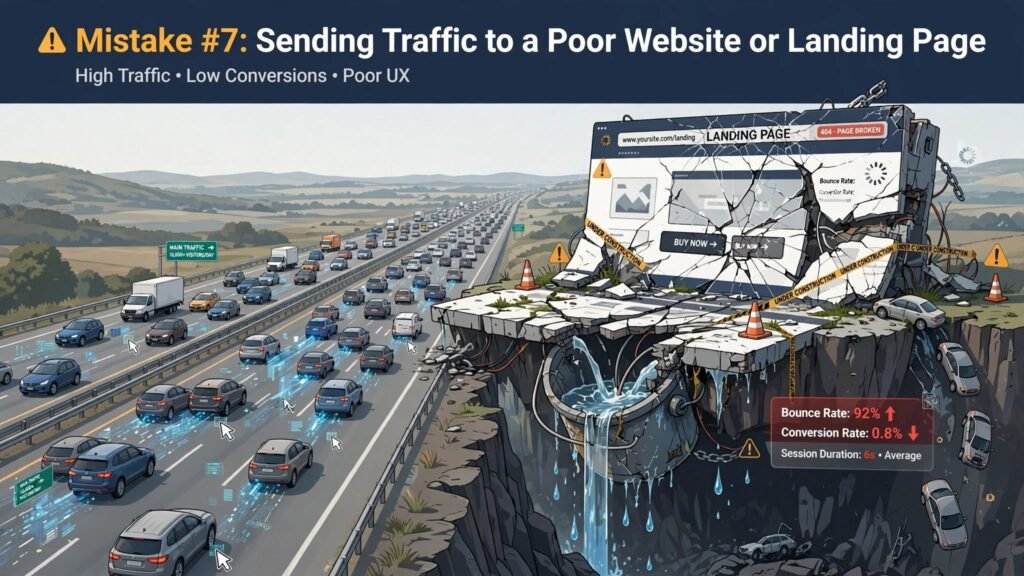
Driving visitors to your website is only the first step of a successful digital marketing strategy. If those visitors arrive on a slow, confusing, outdated, or poorly designed website, they may leave without taking any action. This is why sending traffic to a poor website or landing page is another major digital marketing mistake. Businesses may invest heavily in SEO, Google Ads, Meta Ads, social media marketing, and content marketing, but a weak website experience can prevent that traffic from turning into qualified leads and customers.
Website experience has a direct impact on conversions. Visitors should be able to understand what your business offers, why it matters, and what they should do next within a few seconds. If important information is difficult to find, navigation is confusing, forms are too complicated, or the website does not appear trustworthy, potential customers may leave before contacting the business. This can result in a high bounce rate, low conversion rate, and wasted marketing investment.
There are several common website and landing-page problems that can negatively affect digital marketing results. These include slow-loading pages, poor mobile design, broken links, excessive pop-ups, unclear messaging, weak headlines, difficult navigation, lengthy forms, outdated information, poor-quality visuals, and missing calls-to-action. A landing page that contains too much unnecessary information can also distract visitors from the primary conversion goal.
Page speed is particularly important because users expect websites to load quickly. A slow website can create frustration and reduce the likelihood of users exploring additional pages or completing a form. Businesses should also prioritize mobile responsiveness, as many potential customers access websites through smartphones. A website that looks good on desktop but is difficult to use on mobile can lose valuable traffic and leads.
User experience (UX) should be considered throughout the website. Clear navigation, readable content, logical page structure, accessible buttons, consistent design, and easy-to-use forms can make the customer journey smoother. Every page should guide visitors toward a relevant next step.
Clear CTAs are another essential part of conversion-focused landing pages. Instead of leaving visitors wondering what to do, businesses should use direct calls-to-action such as “Get a Free Consultation,” “Request a Quote,” “Book a Call,” “Contact Us,” or “Get Started.” The CTA should be visible, relevant to the page content, and connected to a simple conversion process.
A conversion-focused landing page should also match the message that brought the visitor there. For example, if a user clicks a Google Ads advertisement for SEO services, the landing page should immediately provide relevant SEO information rather than directing the visitor to a generic homepage. Consistency between advertisement, keyword, landing page, and CTA can improve conversion opportunities.
Ultimately, the goal is not simply to generate more website traffic but to turn that traffic into qualified leads. By improving page speed, mobile responsiveness, UX, messaging, navigation, CTAs, and landing-page relevance, businesses can make better use of their existing traffic and improve conversion rates. A strong website ensures that SEO, paid advertising, social media, and content marketing efforts have a better chance of producing measurable business results and stronger digital marketing ROI.
Mistake #8: Not Using Data to Optimize Your Digital Marketing
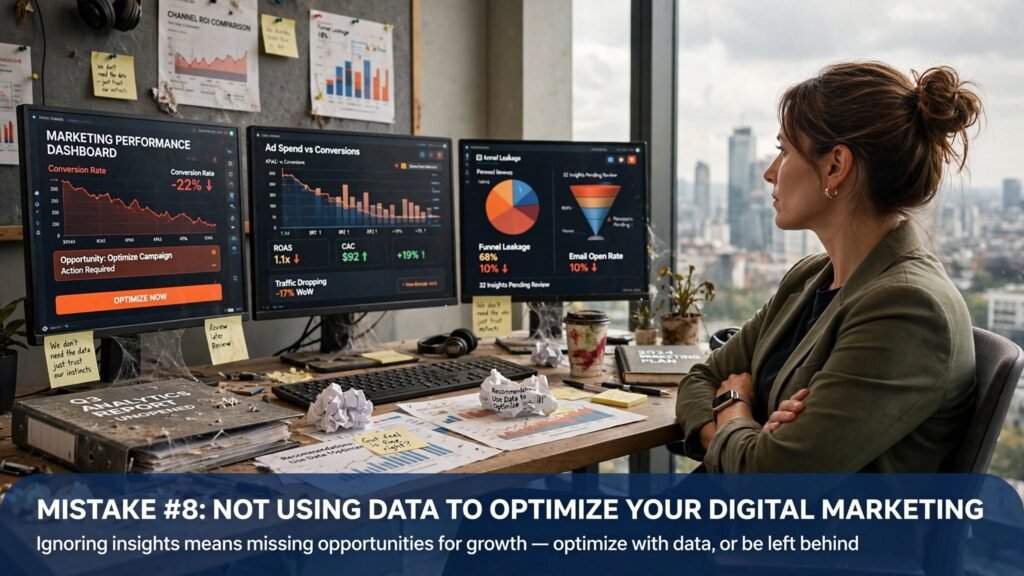
One of the biggest digital marketing mistakes businesses make is making marketing decisions without looking at data. A campaign may appear successful because it receives website traffic, social media engagement, or advertising clicks, but these numbers do not always indicate real business growth. Without proper digital marketing analytics, businesses cannot clearly understand which activities are generating leads, conversions, customers, and revenue. Data provides the evidence needed to improve marketing performance and achieve better digital marketing ROI.
Digital marketing analytics helps businesses understand how users interact with their website, content, advertisements, and other online channels. Instead of relying on assumptions or personal opinions, marketers can use actual performance data to determine what is working and what needs improvement. This is particularly important when managing SEO, content marketing, social media marketing, Google Ads, Meta Ads, and lead-generation campaigns.
One of the first steps in effective data analysis is tracking the right metrics. Website traffic can show how many people are visiting your website, but businesses should also monitor where that traffic comes from and what visitors do after arriving. Important metrics include organic traffic, referral traffic, paid traffic, engagement, leads, conversion rate, cost per lead, customer acquisition cost, revenue, and ROI. Tracking these metrics provides a more complete picture of digital marketing performance.
Google Analytics can help businesses understand website users, traffic sources, landing pages, engagement, conversions, and other important website behavior. Marketers can use this information to identify which pages attract visitors and which pages contribute to conversions. For example, if a blog post generates significant organic traffic but very few enquiries, the business may need to improve its content, internal links, calls-to-action, or related service offers.
Google Search Console is especially useful for monitoring organic search performance. It provides valuable information about search queries, clicks, impressions, click-through rates, and search visibility. Businesses can use this data to identify keywords that are already generating impressions but could potentially achieve more clicks with better titles and meta descriptions. It can also help identify search performance opportunities and technical issues affecting visibility.
Data analysis also helps businesses identify what is failing. A paid campaign with high spending but very few conversions may require audience, keyword, creative, or landing-page optimization. Similarly, a social media campaign with high engagement but no leads may need a stronger CTA or a different conversion strategy. Instead of immediately abandoning a campaign, marketers can examine the data and identify the specific part of the customer journey that needs improvement.
Data-driven digital marketing optimization should be an ongoing process. Businesses should regularly review performance, identify trends, test different strategies, and make evidence-based adjustments. A/B testing headlines, landing pages, advertisements, CTAs, audiences, and content formats can help determine which approaches produce better results.
Ultimately, data transforms digital marketing from guesswork into a measurable process. By using digital marketing analytics, tracking traffic, leads, conversions, and ROI, and making effective use of Google Analytics and Google Search Console, businesses can make smarter decisions and continuously improve their digital marketing strategy. The goal is not simply to collect more data—it is to turn that data into actionable insights that generate better traffic, qualified leads, conversions, and long-term business growth.
Mistake #9: Expecting Results Too Quickly

Expecting immediate results is one of the most common digital marketing mistakes businesses make. Many companies launch an SEO campaign, publish a few blog posts, run social media campaigns, or start Google Ads and expect significant traffic, leads, and sales within a very short period. When those results do not appear immediately, they may assume that their digital marketing strategy is failing and completely change their approach. In reality, different digital marketing channels work at different speeds, and sustainable growth requires patience, consistency, testing, and continuous optimization.
SEO takes time because search engines need to discover, crawl, understand, and evaluate website content before rankings can improve. Building domain authority, earning quality backlinks, creating useful content, and improving technical SEO are long-term processes. Organic traffic may gradually increase as a website builds search visibility and establishes authority for relevant keywords. This means businesses should evaluate SEO based on trends and progress rather than expecting instant results.
Paid advertising generally works faster than SEO because Google Ads and Meta Ads can start generating impressions, clicks, and potential conversions soon after campaigns are launched. However, fast traffic does not automatically mean profitable results. Advertising campaigns often require audience testing, keyword optimization, creative testing, landing-page improvements, and conversion tracking before they reach efficient performance. Therefore, even paid advertising requires a testing and optimization period.
Consistency is another important factor in achieving sustainable digital marketing results. Publishing useful content regularly, maintaining SEO efforts, testing advertising campaigns, engaging with the audience, and analyzing performance can gradually strengthen a brand’s online presence. Stopping campaigns too early can prevent businesses from collecting enough data to understand what is working.
Testing is equally important. Instead of making major changes based on a few days of performance, marketers should test different headlines, keywords, audiences, ad creatives, content formats, landing pages, and calls-to-action. These tests can reveal which elements are contributing to better traffic, engagement, leads, and conversions.
Businesses should also learn when to optimize instead of completely changing their strategy. Poor results do not always mean the entire digital marketing strategy is wrong. Sometimes the problem may be a specific keyword, audience segment, advertisement, landing page, CTA, or content format. For example, if a campaign is generating clicks but not leads, improving the landing page or offer may be more effective than abandoning the entire campaign.
Data should guide these decisions. By monitoring traffic, conversion rates, cost per lead, keyword rankings, engagement, customer acquisition cost, and digital marketing ROI, businesses can identify whether performance is improving, declining, or simply requiring further optimization.
The goal of digital marketing is not to achieve temporary results as quickly as possible. It is to build sustainable digital marketing results that continue generating visibility, qualified traffic, leads, customers, and revenue over time. By setting realistic expectations, maintaining consistency, testing different approaches, and making data-driven optimizations, businesses can create a stronger and more reliable digital marketing strategy instead of constantly starting from zero.
How to Fix Your Digital Marketing Strategy

If your digital marketing is not delivering the expected traffic, leads, conversions, or sales, the solution is not always to completely change your approach. In many cases, you need to identify the weaknesses in your existing digital marketing strategy and optimize them step by step. Understanding how to fix digital marketing mistakes can help businesses improve their online presence, generate better leads, and achieve stronger digital marketing results.
Audit Your Existing Digital Marketing Strategy

The first step is to conduct a complete audit of your current digital marketing strategy. Review your website, SEO performance, social media channels, content marketing efforts, Google Ads campaigns, Meta Ads, email marketing, and conversion tracking. Look at what is working and what is not.
Check important metrics such as website traffic, keyword rankings, engagement rate, conversion rate, cost per lead, bounce rate, and digital marketing ROI. This audit can reveal whether your current strategy is generating meaningful business results or simply producing activity without conversions.
Identify Your Biggest Marketing Mistakes
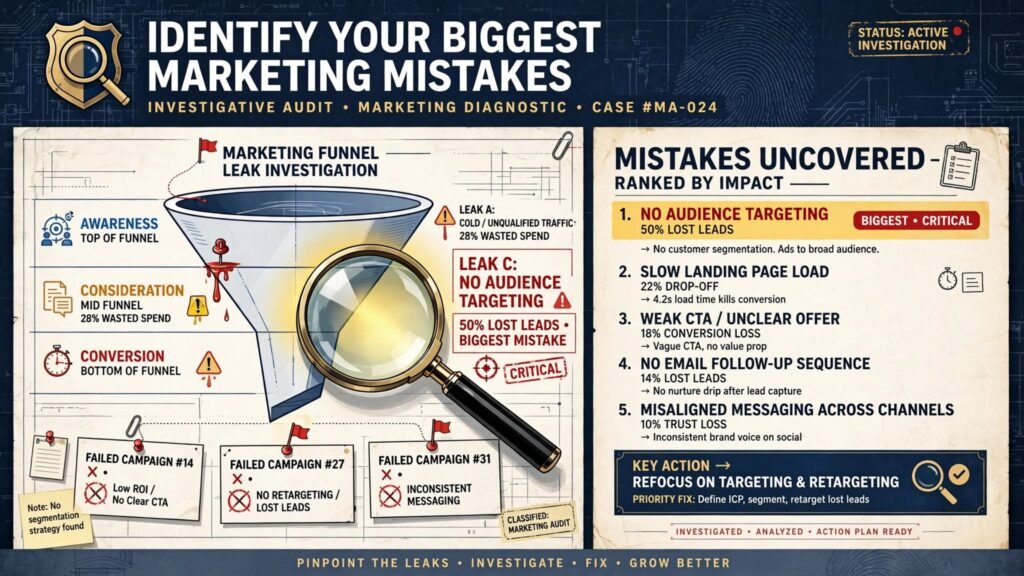
Once you complete the audit, identify the biggest digital marketing mistakes affecting your performance. These may include targeting the wrong audience, using irrelevant keywords, publishing content without a clear purpose, ignoring search intent, having poor landing pages, or running paid campaigns without proper tracking.
Identifying these digital marketing strategy mistakes is important because fixing the biggest problems first can produce better results than making random changes across every marketing channel.
Define Your Target Audience and Goals
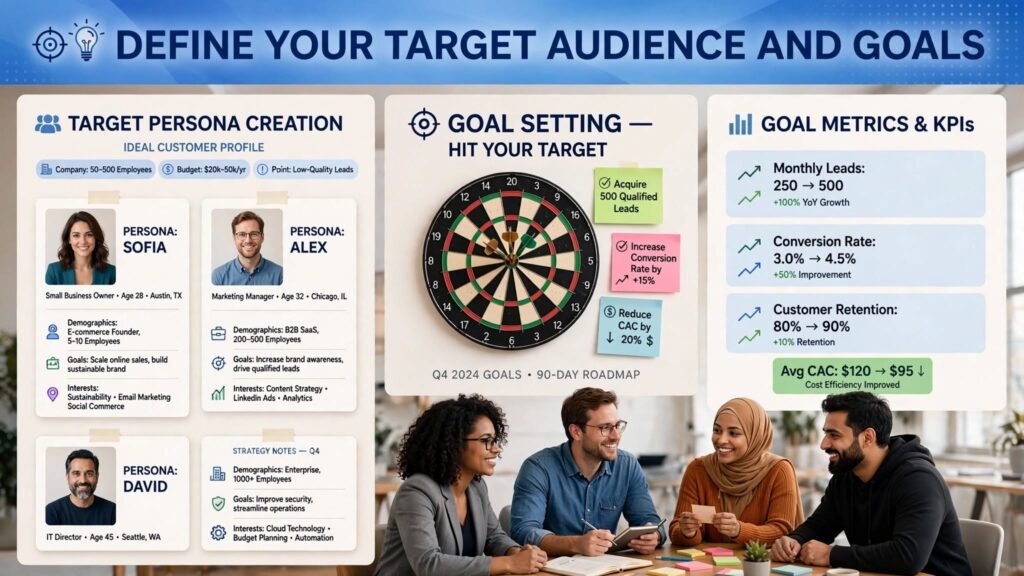
A successful digital marketing strategy needs a clearly defined target audience and measurable goals. Understand who your ideal customers are, what problems they have, what they search for online, and what influences their buying decisions.
Your goals should also be specific. Instead of simply trying to “increase online visibility,” define objectives such as increasing organic traffic, generating qualified leads, improving conversion rates, reducing cost per lead, or increasing sales. A clear lead generation strategy makes it easier to measure progress.
Improve SEO and Content Marketing
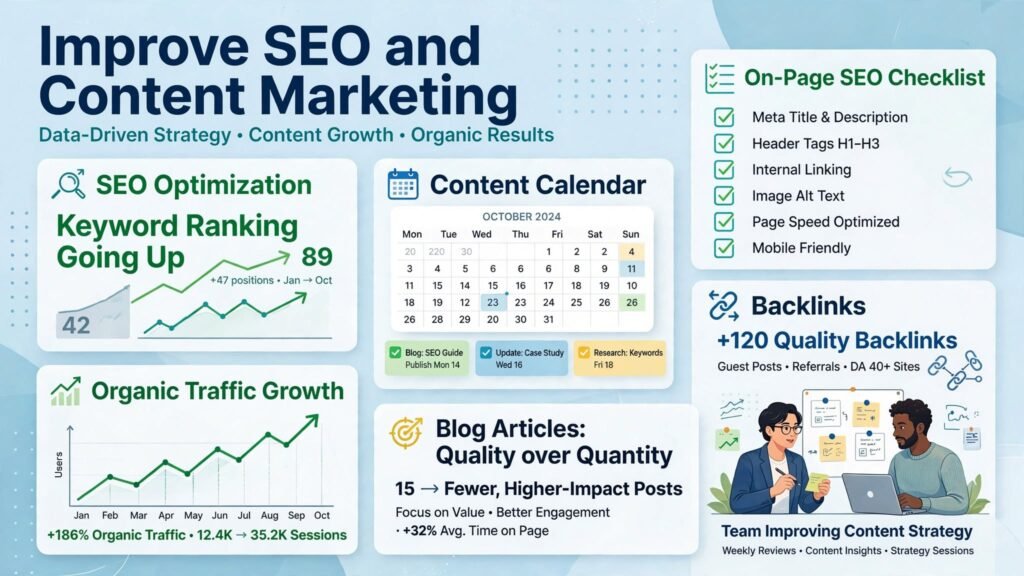
SEO and content marketing should work together. Avoid common SEO mistakes such as keyword stuffing, poor website structure, slow pages, missing metadata, weak internal linking, and creating content that does not match search intent.
At the same time, improve your content marketing strategy by creating useful, original, and audience-focused content. Blog posts, landing pages, videos, guides, and social media content should answer customer questions and support different stages of the buyer journey.
Optimize Social Media and Paid Advertising
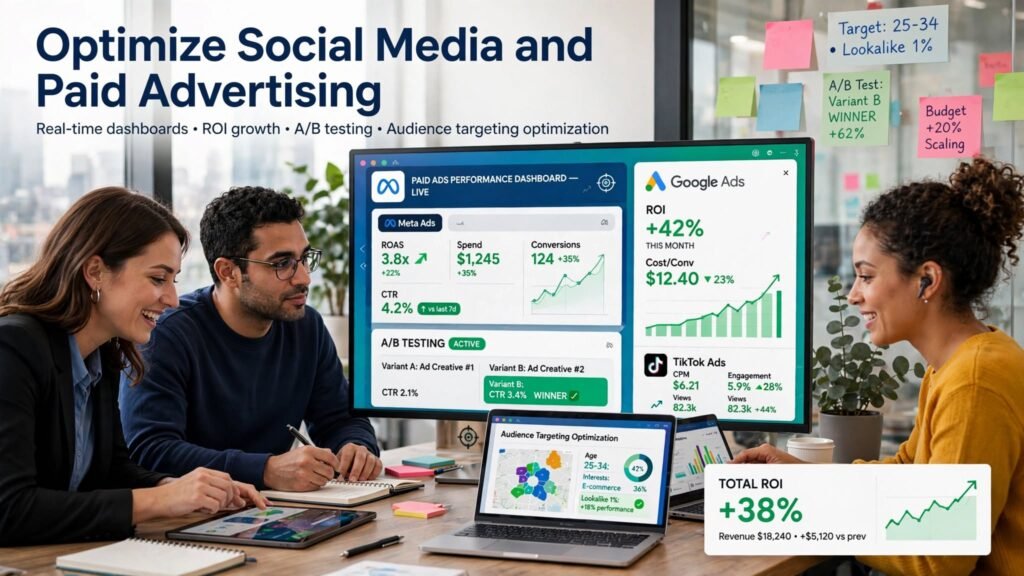
Social media marketing should focus on more than followers and likes. Avoid common social media marketing mistakes by creating content with clear objectives such as engagement, brand awareness, website traffic, lead generation, or conversions.
For paid advertising, review your Google Ads and Meta Ads campaigns regularly. Common Google Ads mistakes and paid advertising mistakes include poor keyword targeting, weak ad copy, incorrect audience targeting, ineffective landing pages, and inadequate conversion tracking. Testing different audiences, creatives, keywords, offers, and landing pages can significantly improve campaign performance.
Track Performance and Continuously Improve
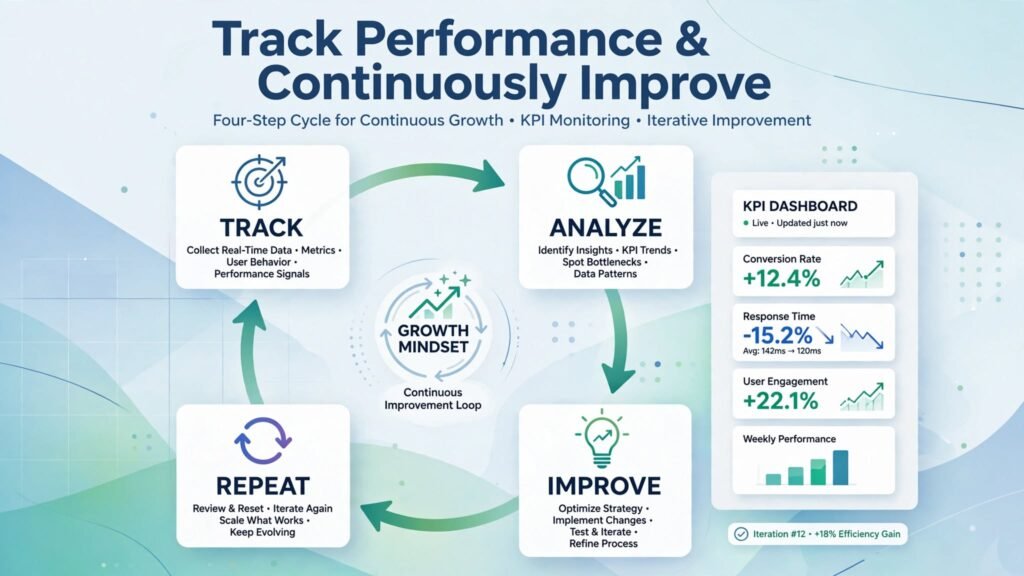
The final step is continuous digital marketing optimization. Digital marketing is not a one-time activity where you create a campaign and wait for results. You need to monitor performance, analyze data, test new ideas, and make regular improvements.
Track metrics such as organic traffic, leads, conversions, engagement, cost per acquisition, return on ad spend, keyword rankings, and overall digital marketing ROI. Use these insights to understand which channels are producing results and where your budget or effort should be adjusted.
By auditing your strategy, fixing digital marketing mistakes, understanding your audience, improving SEO and content marketing, optimizing social media and paid advertising, and continuously analyzing performance, you can build a stronger and more sustainable digital marketing strategy. The goal is not simply to do more marketing—it is to make every marketing activity more purposeful, measurable, and focused on real business growth.
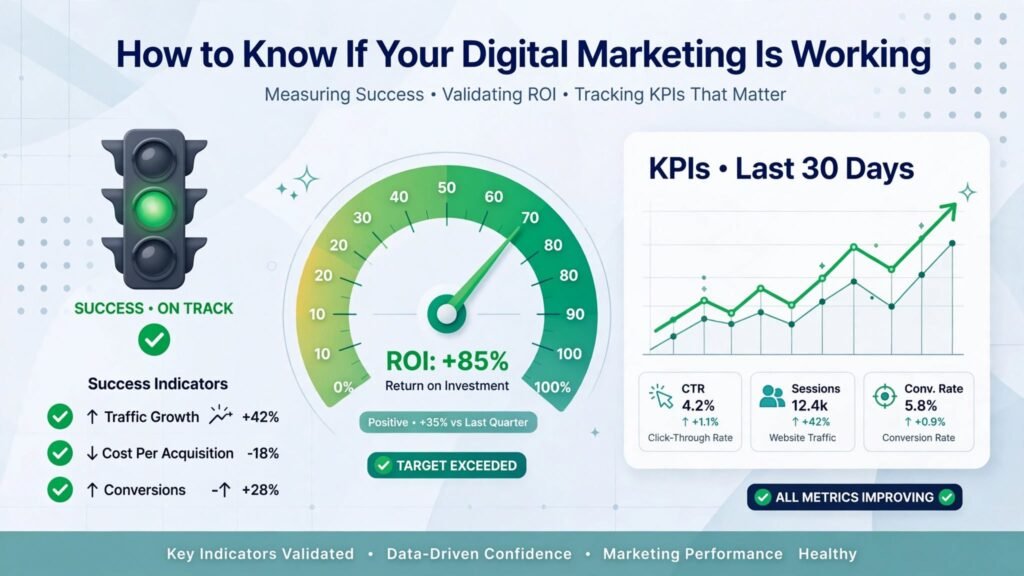
One of the biggest challenges in digital marketing is knowing whether your efforts are actually producing business results. Getting more followers, likes, impressions, or website visits may look positive, but these numbers do not always mean your digital marketing strategy is successful. To understand whether your marketing is working, you need to track the right performance metrics and connect them with your business goals.
Website Traffic
Website traffic is one of the first metrics you should monitor. Increasing traffic can indicate that your SEO, content marketing, social media marketing, Google Ads, or Meta Ads campaigns are attracting people to your website.
However, traffic alone is not enough. You should also analyze where visitors are coming from, which pages they visit, how long they stay, and whether they take meaningful actions. High traffic with very few conversions may indicate targeting problems, poor content, weak landing pages, or other digital marketing mistakes.
Qualified Leads
The number of qualified leads is more important than simply counting every enquiry. A successful lead generation strategy should attract people who are genuinely interested in your products or services.
Track how many leads come from organic search, social media, paid advertising, email marketing, and other channels. If a campaign generates a large number of leads but most of them are irrelevant, your targeting or messaging may need improvement.
Conversion Rate
Your conversion rate shows how effectively your website or campaign turns visitors into leads, customers, or other desired actions. A low conversion rate can indicate problems with your offer, website experience, landing page, content, call-to-action, or audience targeting.
Improving conversion rates is an important part of digital marketing optimization because you can generate better results without necessarily increasing your website traffic or advertising budget.
Customer Acquisition Cost
Customer Acquisition Cost (CAC) measures how much your business spends to acquire a new customer. This includes costs related to advertising, content marketing, sales, software, and other marketing activities.
If your customer acquisition cost is continuously increasing, you should analyze your campaigns and identify areas where your digital marketing strategy can become more efficient. Reducing unnecessary spending while maintaining conversions can significantly improve profitability.
Return on Ad Spend
For businesses running paid advertising, Return on Ad Spend (ROAS) is an important metric. ROAS helps you understand how much revenue is generated for the money spent on advertising.
For example, if you spend ₹10,000 on Google Ads and generate ₹40,000 in attributed revenue, your ROAS is 4x. However, ROAS should always be evaluated alongside profit margins, customer acquisition cost, conversion quality, and overall business performance.
Overall Digital Marketing ROI
Ultimately, the most important measurement is your overall digital marketing ROI. Return on investment helps you understand whether your total marketing investment is generating sufficient business value.
Instead of focusing on individual metrics in isolation, evaluate website traffic, qualified leads, conversion rate, customer acquisition cost, ROAS, revenue, and profit together. This gives you a clearer picture of your digital marketing results.
When these metrics are consistently improving, your digital marketing strategy is likely moving in the right direction. If they are not, the data can help you identify what needs to be changed. Successful digital marketing is not about collecting the biggest numbers—it is about turning marketing activity into measurable business growth.
Conclusion: Turn Digital Marketing Mistakes Into Growth Opportunities
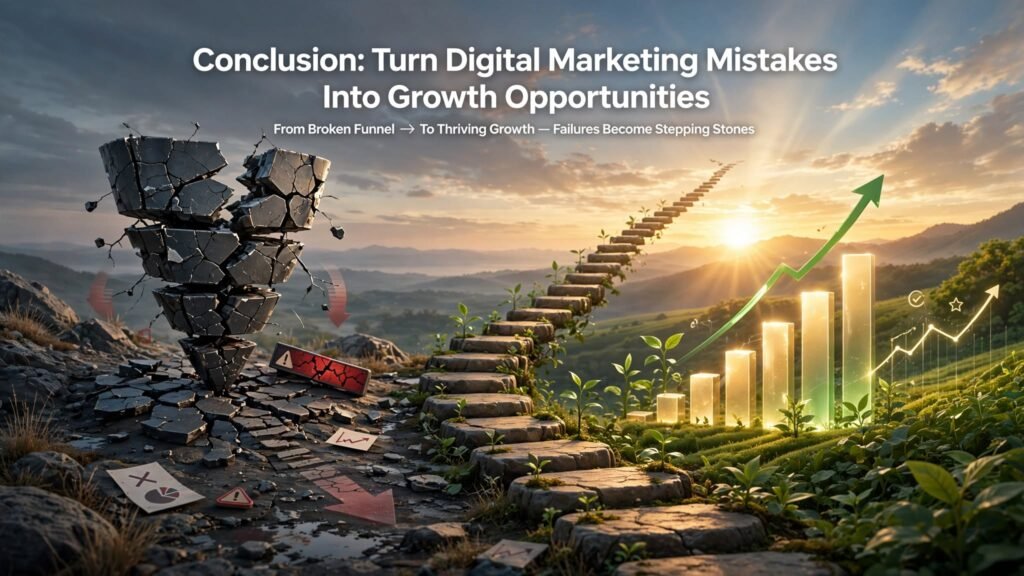
Digital marketing does not fail simply because a business is not posting enough content, spending enough on advertising, or getting enough website traffic. In many cases, the real problem lies in the strategy behind those activities. The 9 digital marketing mistakes discussed in this guide show how small gaps in planning, targeting, SEO, content, advertising, website optimization, and analytics can prevent businesses from achieving their desired digital marketing results.
The first step toward improvement is to review your existing digital marketing strategy honestly. Identify what is working, what is underperforming, and where your biggest digital marketing mistakes are affecting traffic, leads, conversions, and revenue. Instead of changing everything at once, focus on the areas that can create the greatest impact.
Your target audience should always remain at the center of your marketing strategy. When you understand your customers, their problems, search behavior, preferences, and buying journey, it becomes easier to create relevant content and campaigns. A strong audience strategy also helps improve your SEO, social media marketing, content marketing, and paid advertising performance.
SEO and content should work together to attract the right people through search engines and provide genuine value once they arrive on your website. At the same time, Google Ads and Meta Ads should be supported by accurate targeting, strong creative, relevant landing pages, and proper conversion tracking. Avoiding common SEO mistakes, content marketing mistakes, and Google Ads mistakes can make your marketing budget significantly more effective.
Most importantly, use data instead of assumptions. Website traffic, qualified leads, conversion rate, customer acquisition cost, ROAS, keyword rankings, engagement, and overall digital marketing ROI can tell you what is actually happening. Data-driven decision-making allows you to continuously test, measure, optimize, and improve your campaigns.
A successful business does not need a perfect digital marketing strategy from day one. It needs a consistent, measurable, and conversion-focused digital marketing strategy that evolves with customer behavior and market changes. When you treat mistakes as opportunities to learn and optimize, your digital marketing efforts can become a powerful engine for sustainable growth.
Ready to Fix Your Digital Marketing?
If your business is struggling with SEO, social media, Google Ads, Meta Ads, content marketing, website performance, or lead generation, The Rohit Creative Hub can help you build a more strategic and results-driven online presence.
From digital marketing strategy and SEO to social media marketing, paid advertising, content marketing, branding, and website development, The Rohit Creative Hub focuses on turning digital efforts into measurable business growth.
Don’t let digital marketing mistakes hold your business back. Identify the gaps, fix the strategy, and start building better digital marketing results.
👉 Grow Digital. Grow Smart. — The Rohit Creative Hub