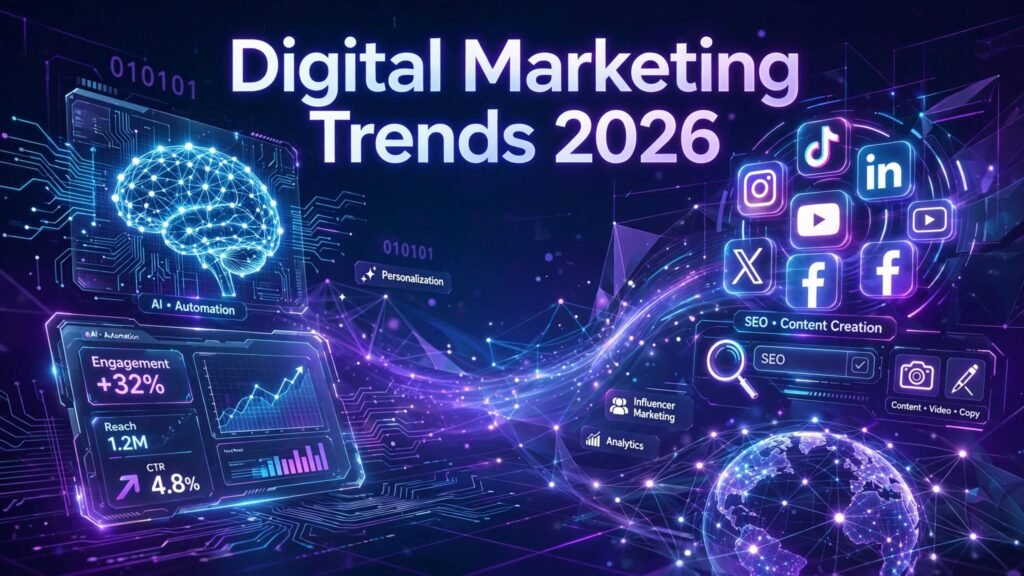
Digital marketing is changing faster than ever, and businesses that want to remain visible, competitive, and relevant need to understand the digital marketing trends 2026 is bringing. From search engines and social media to paid advertising and content creation, technology is changing how brands attract customers and build relationships with their audiences. The latest digital marketing trends are not limited to new platforms; they are also changing how marketers plan campaigns, understand customers, create content, and measure results.
One of the biggest changes in the digital marketing trends 2026 landscape is the growing role of Artificial Intelligence (AI). AI is becoming an important part of content creation, customer research, data analysis, personalization, advertising, and marketing automation. Instead of replacing marketing completely, AI is helping marketers complete repetitive tasks faster and use data more effectively. This makes AI and automation important elements of a modern digital marketing strategy.
At the same time, customer behavior is becoming more complex. People are searching for information across Google, social media platforms, YouTube, and AI-powered search experiences. They expect faster answers, personalized content, useful information, and seamless experiences. Because of this, businesses can no longer depend on a single marketing channel. A strong digital marketing strategy needs to combine SEO, social media marketing, content marketing, paid advertising, email marketing, analytics, and emerging AI-focused strategies.
The latest digital marketing trends also show a shift from simply generating traffic to generating meaningful business outcomes. Website visits, followers, and impressions are useful, but businesses increasingly need to focus on leads, conversions, customer engagement, retention, and return on investment. This means marketers need to continuously analyze campaign performance and optimize their digital marketing strategy according to customer behavior and business objectives.
So, what should marketers focus on in 2026? AI marketing, AI search optimization, zero-click searches, social search, short-form video, personalized marketing, quality content, marketing automation, and performance-driven advertising are some of the major areas shaping the future of digital marketing.
Understanding these digital marketing trends 2026 is important for businesses of every size. Whether you are a startup, local business, e-commerce brand, or established company, adapting your digital marketing strategy to changing customer expectations can help you build stronger visibility and sustainable growth. In this guide, we will explore the latest digital marketing trends that marketers and businesses should pay attention to in 2026.
1. AI Is Transforming Digital Marketing
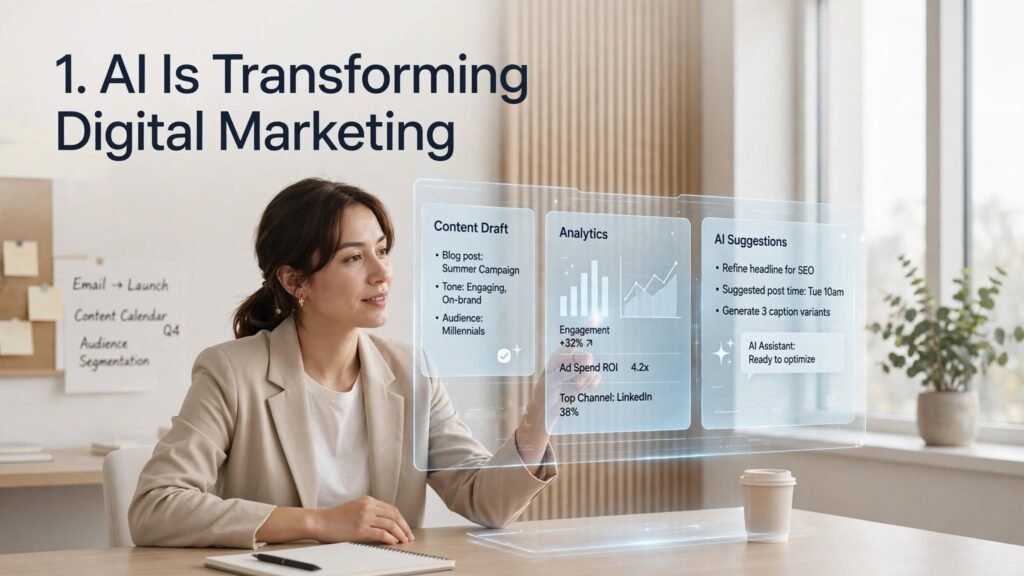
Artificial Intelligence has become one of the most important forces shaping digital marketing in 2026. The growing use of AI marketing is changing how businesses create content, understand customers, analyze data, and automate marketing activities. AI in digital marketing is no longer limited to experimental tools; it is becoming a practical part of everyday marketing strategies. Businesses are using artificial intelligence marketing solutions to improve efficiency, deliver personalized experiences, and make faster, data-driven decisions.
How AI Is Changing Marketing
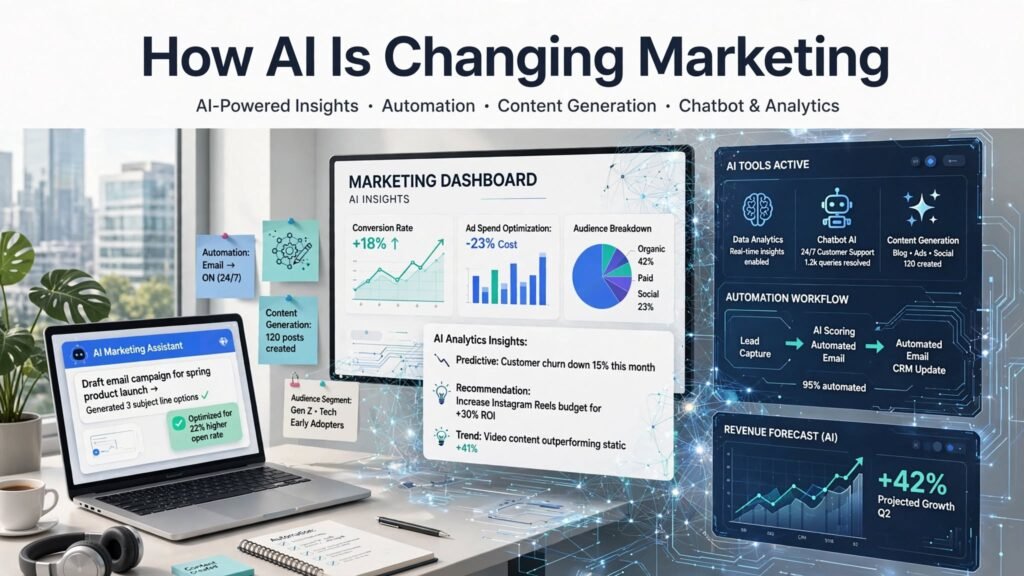
One of the biggest applications of AI in digital marketing is AI content creation. AI-powered tools can help marketers generate content ideas, create initial drafts, develop social media copy, summarize information, and support creative workflows. However, human expertise remains important for maintaining brand voice, originality, accuracy, and strategic direction. The most effective AI marketing approach combines artificial intelligence with human creativity rather than relying entirely on automated content.
Another major advantage of artificial intelligence marketing is improved customer insights. AI can analyze large amounts of customer data and identify patterns in searches, website behavior, purchases, engagement, and interactions. These insights help marketers understand what customers want, which content attracts attention, and where potential customers may leave the marketing funnel.
Predictive analytics is another important area where AI in digital marketing is making an impact. By analyzing historical and behavioral data, AI systems can help marketers identify potential trends, forecast customer actions, and improve campaign planning. This can support decisions related to audience targeting, content distribution, lead scoring, and advertising optimization.
Marketing automation is also becoming more intelligent through AI marketing. Businesses can automate repetitive activities such as email workflows, audience segmentation, customer responses, campaign analysis, and lead nurturing. AI can help determine when and how customers should receive specific messages, making marketing automation more relevant and efficient.
Benefits of AI Marketing
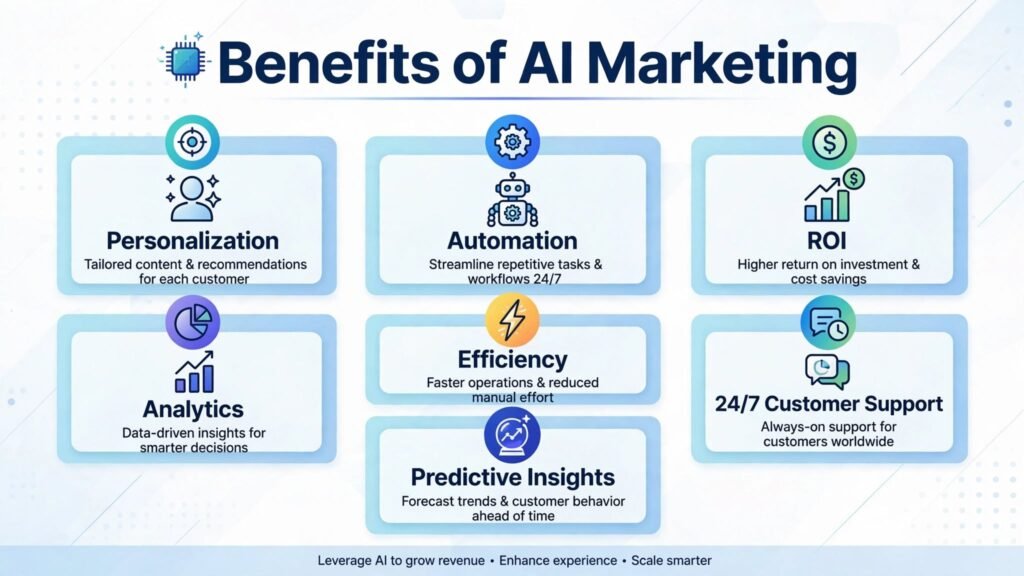
The first major benefit of AI marketing is faster execution. Tasks that previously required significant manual effort can be completed more efficiently with AI-powered tools. This allows marketers to spend more time on strategy, creativity, and optimization.
AI also enables better personalization. Instead of delivering the same message to every customer, businesses can use customer data and AI insights to create more relevant experiences for different audience segments.
Finally, AI in digital marketing supports data-driven decisions. Marketers can analyze campaign performance, customer behavior, and market patterns more efficiently, helping them make informed decisions instead of relying only on assumptions.
As AI marketing, predictive analytics, automation, and personalization continue to develop, artificial intelligence marketing will remain a major component of modern digital marketing strategies.
2. AI Search Optimization Is Becoming Essential
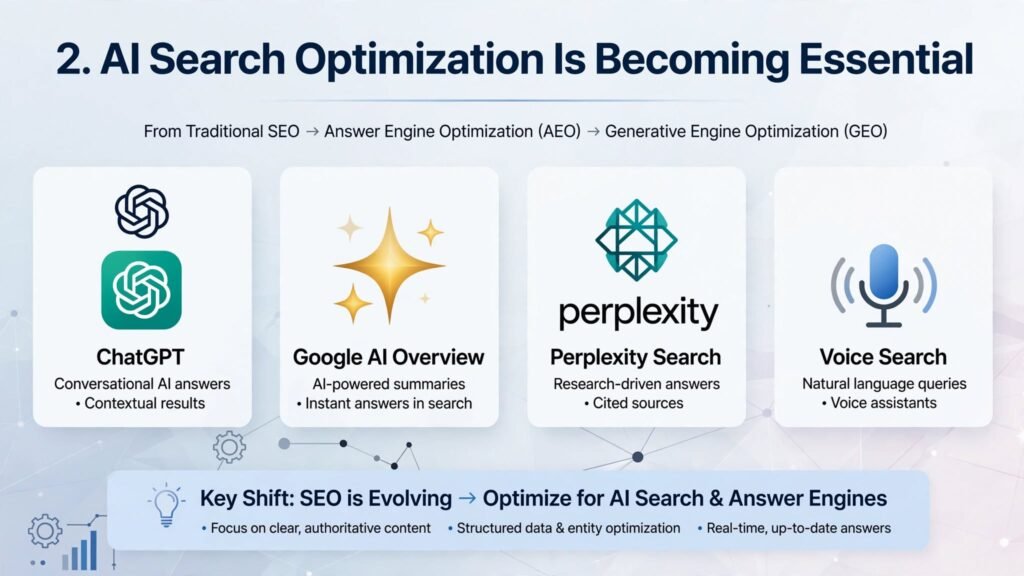
Search behavior is changing rapidly, and AI search optimization is becoming an important part of modern digital marketing. Traditional search engines are no longer the only way people discover information, brands, products, and services. Users are increasingly interacting with AI-powered search experiences that provide direct answers, summaries, recommendations, and sources instead of simply presenting a list of blue links. This shift is one of the most important SEO trends 2026 that businesses need to understand.
What Is AI Search Optimization?
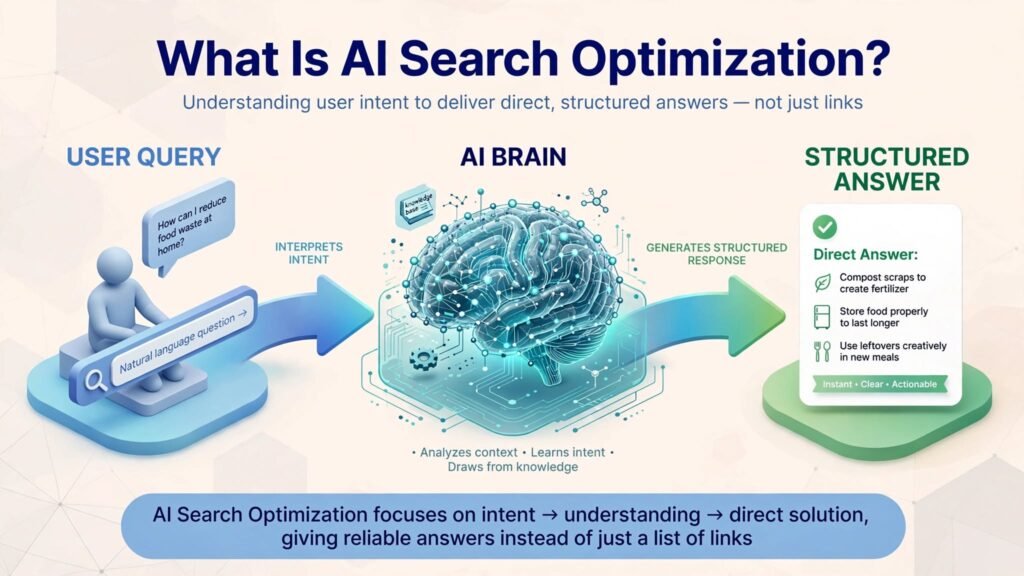
AI search optimization is the process of creating and structuring online content so that it can be better understood, referenced, and surfaced by AI-powered search systems. While traditional SEO focuses heavily on improving visibility in search engine results pages, AI search optimization focuses on making information clear, relevant, authoritative, and useful for AI-driven search experiences.
The goal of AI search optimization is not to replace SEO. Instead, it extends traditional SEO into a new search environment. Businesses still need technically sound websites, relevant keywords, high-quality content, internal linking, strong topical coverage, and trustworthy information. However, they also need content that clearly answers questions and provides meaningful context.
How AI Search Differs From Traditional Search
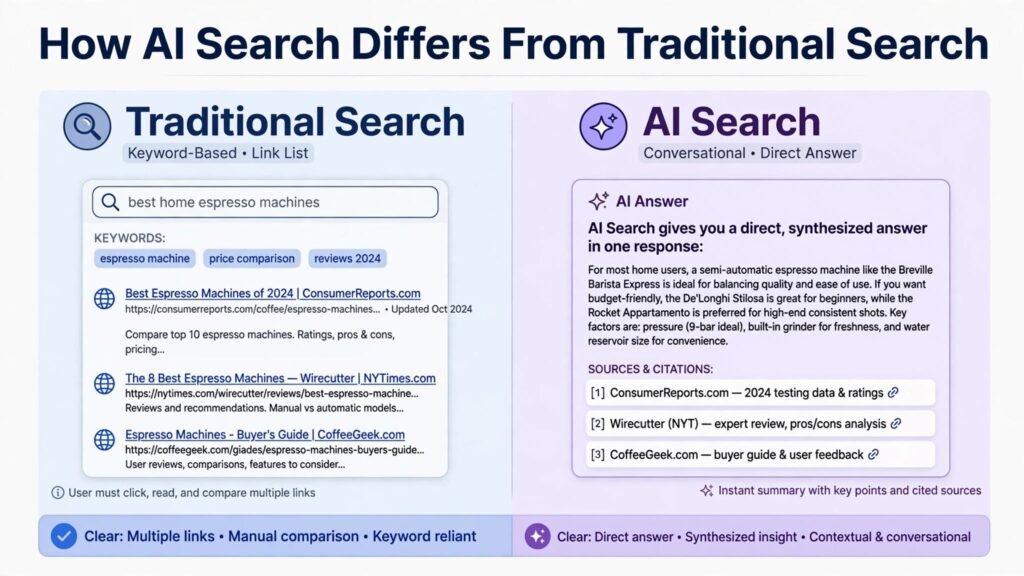
Traditional search generally requires users to enter a query and choose from multiple search results. AI search can understand conversational questions, combine information from different sources, and generate a summarized response. This means users may get the information they need without visiting several websites.
This change is creating new challenges for businesses. Ranking on a traditional search results page is no longer the only objective. Brands also need to increase the likelihood that their content will be recognized as a useful and credible source within AI-generated answers. Therefore, AI search optimization is becoming an important extension of traditional SEO.
Why Businesses Need GEO in 2026
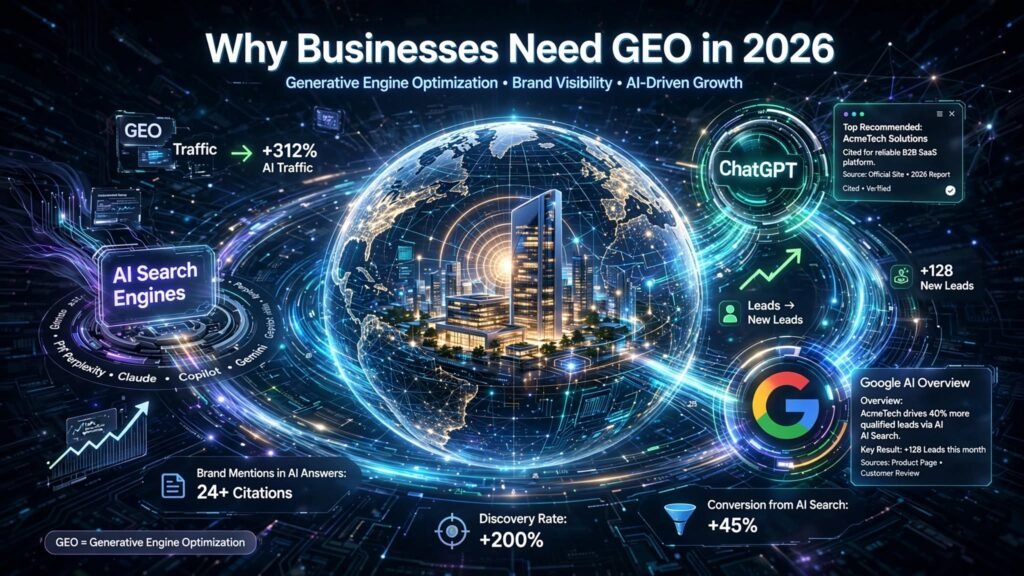
GEO, or Generative Engine Optimization, is another important concept within the evolving search landscape. GEO focuses on improving a brand’s visibility and representation in generative AI experiences. As AI search becomes more influential, businesses need to think beyond traditional rankings and consider how their expertise, brand information, and content can be discovered and understood by AI systems.
The combination of SEO, AI search optimization, and GEO can help businesses build stronger search visibility across traditional and AI-powered discovery channels. In 2026, businesses that continue producing useful, original, well-structured, and authoritative content will be better positioned to adapt to these changes.
For businesses looking to strengthen their visibility across traditional search and emerging AI search platforms, investing in a comprehensive SEO and GEO strategy can be an important step toward long-term digital growth.
Internal Link: Explore our SEO / GEO services to build a stronger search visibility strategy for your business.
3. Zero-Click Search Is Changing SEO
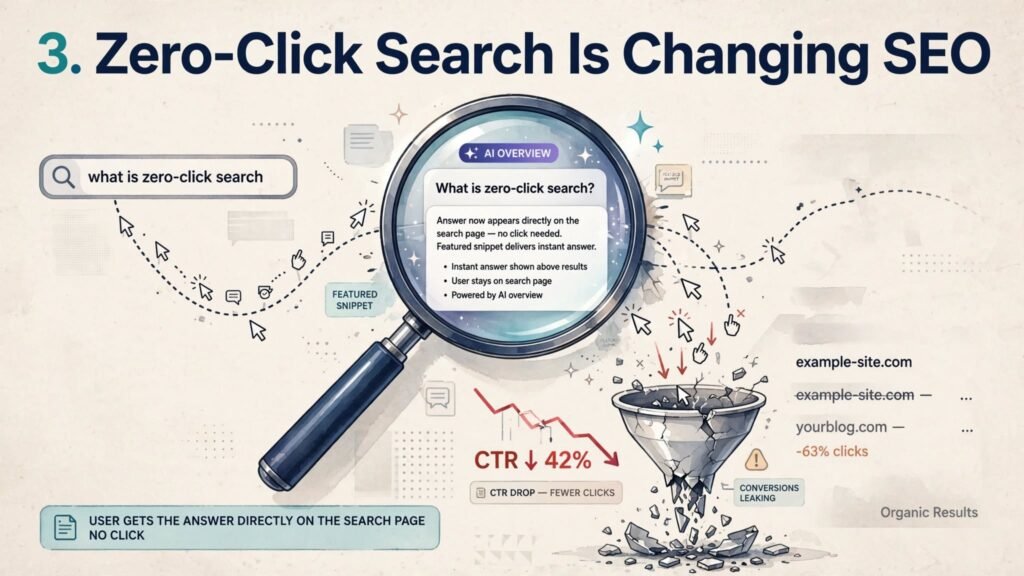
Search engine behavior is changing, and zero-click search has become one of the most important SEO trends 2026. In traditional search, users generally clicked a website from the search results to find the information they needed. With zero-click search, users can often find an answer directly on the search results page without visiting a website. This shift is changing how businesses think about traffic, rankings, content, and brand visibility.
Zero-click marketing focuses on building visibility and providing value even when users do not click through to a website. Instead of measuring success only through website visits, marketers need to consider impressions, brand mentions, search visibility, engagement, and the ability of content to influence customers during their search journey.
Featured Snippets
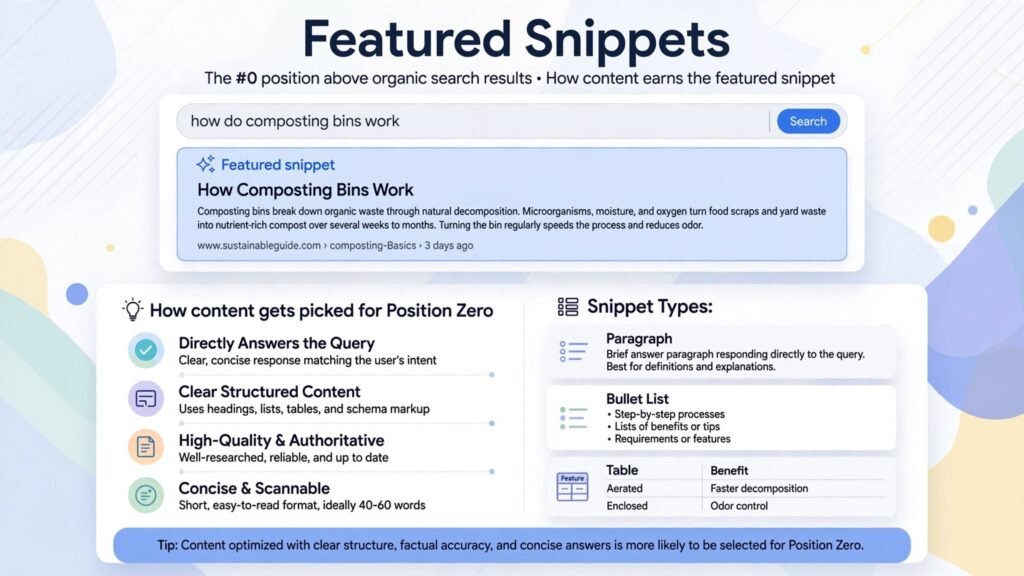
Featured snippets are one of the most recognizable examples of zero-click search. Search engines may display a direct answer from a webpage at the top of the results. Users can sometimes get the information they need without opening the source website. For businesses, earning a featured snippet can increase visibility and establish topical authority, even when the number of website clicks varies.
AI Overviews
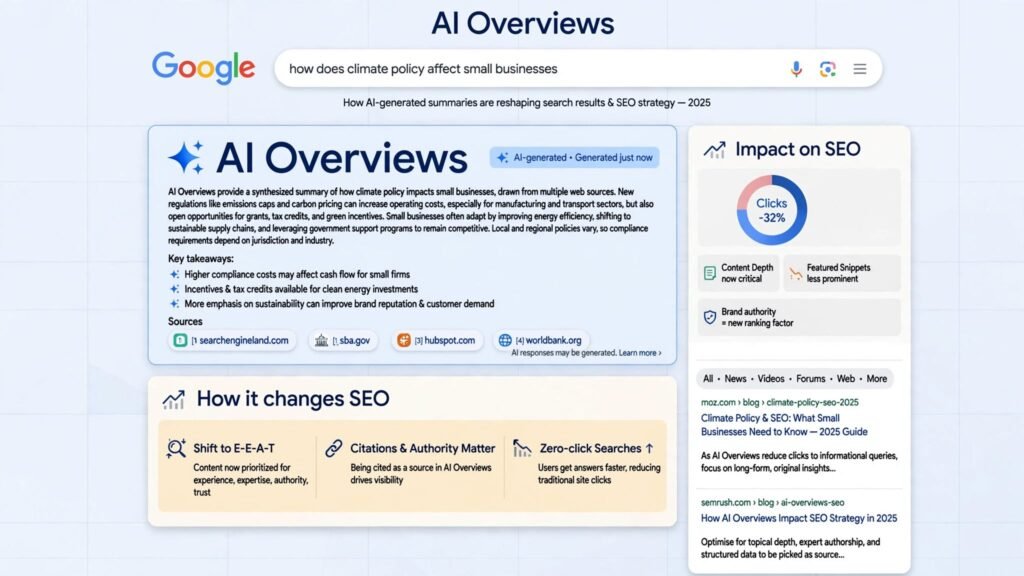
The growth of AI Overviews is another major development influencing SEO trends 2026. AI-powered search experiences can summarize information and provide users with direct answers to complex queries. This means businesses need to create content that is clear, useful, well-structured, and supported by credible information. Traditional SEO remains important, but content must also be prepared for changing AI-driven search experiences.
Knowledge Panels
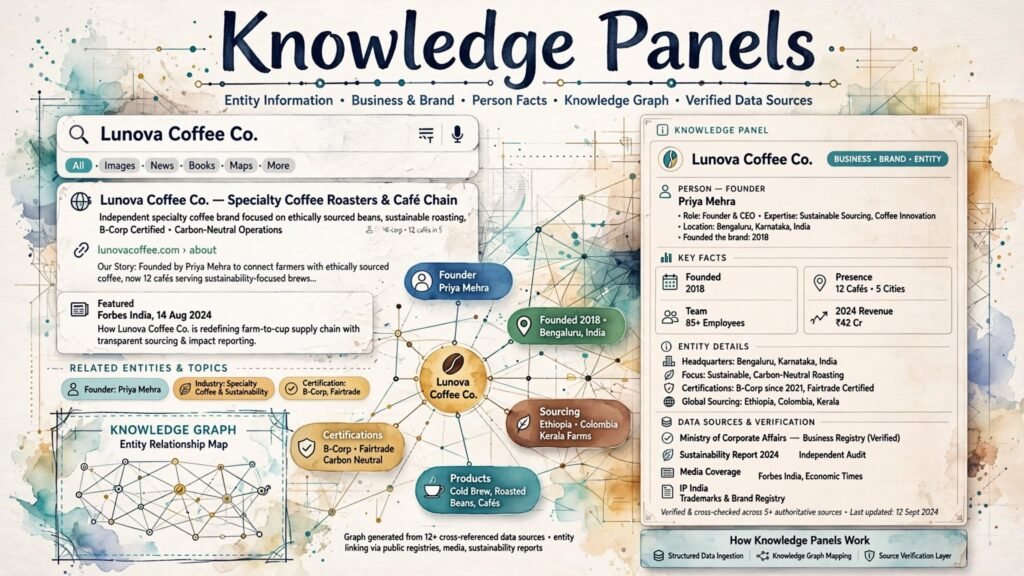
Knowledge panels can provide important information about brands, organizations, people, and other entities directly within search results. They allow users to discover essential information without necessarily visiting a website. Maintaining accurate and consistent brand information across the web can therefore contribute to stronger search visibility.
Search Without Website Visits
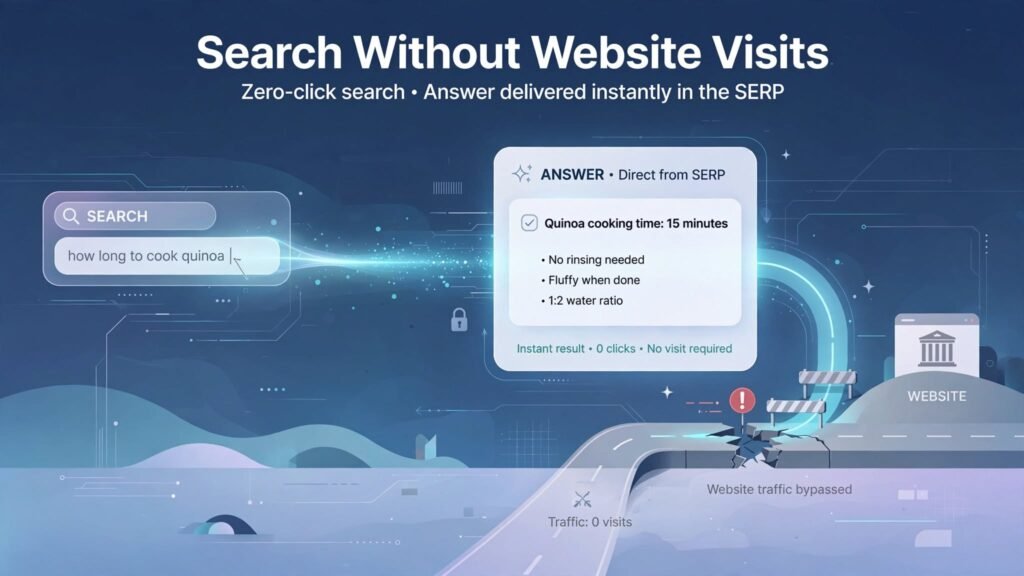
The biggest challenge of zero-click search is that visibility does not always result in a website visit. A user may see a business name, answer, review, or brand information and continue their journey without clicking. However, this does not mean the exposure has no value. A customer may remember the brand and search for it later, visit through another channel, or make a purchase after multiple interactions.
Brand Visibility Beyond Clicks
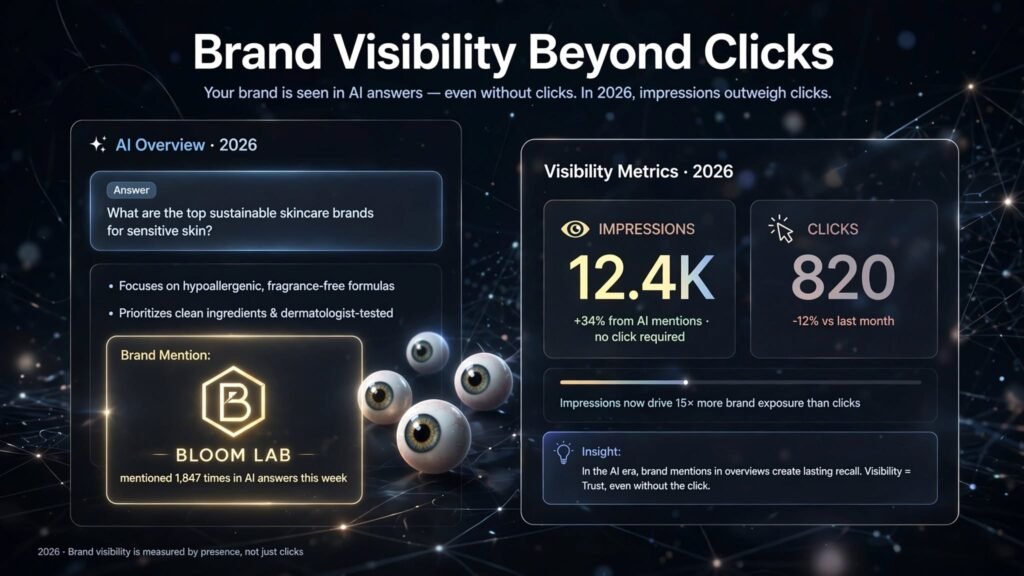
This is where zero-click marketing becomes increasingly important. In 2026, businesses should look beyond clicks and consider the entire search visibility ecosystem. Appearing in featured snippets, AI Overviews, knowledge panels, local results, and other search features can strengthen brand awareness and credibility.
Therefore, successful SEO in 2026 is not simply about getting more clicks. It is about achieving brand visibility beyond clicks and making valuable information available wherever customers search. Businesses that adapt their SEO and zero-click marketing strategies can remain competitive as search continues to evolve.
4. Short-Form Video Will Continue to Dominate
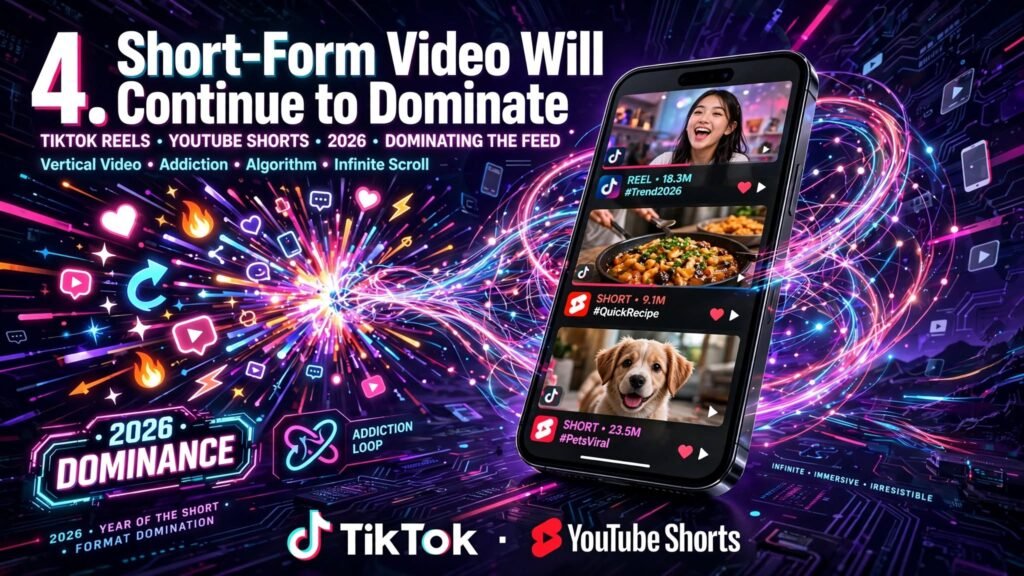
Short-form video has become one of the most powerful formats in modern digital marketing, and its importance is expected to continue growing in 2026. The rise of short-form video marketing is closely connected with changing consumer behavior. People increasingly prefer quick, visually engaging content that delivers useful information, entertainment, or a clear message within a short amount of time. For businesses, this makes short-form video an important part of their social media marketing strategy and one of the major video marketing trends to watch.
Why Short-Form Video Works
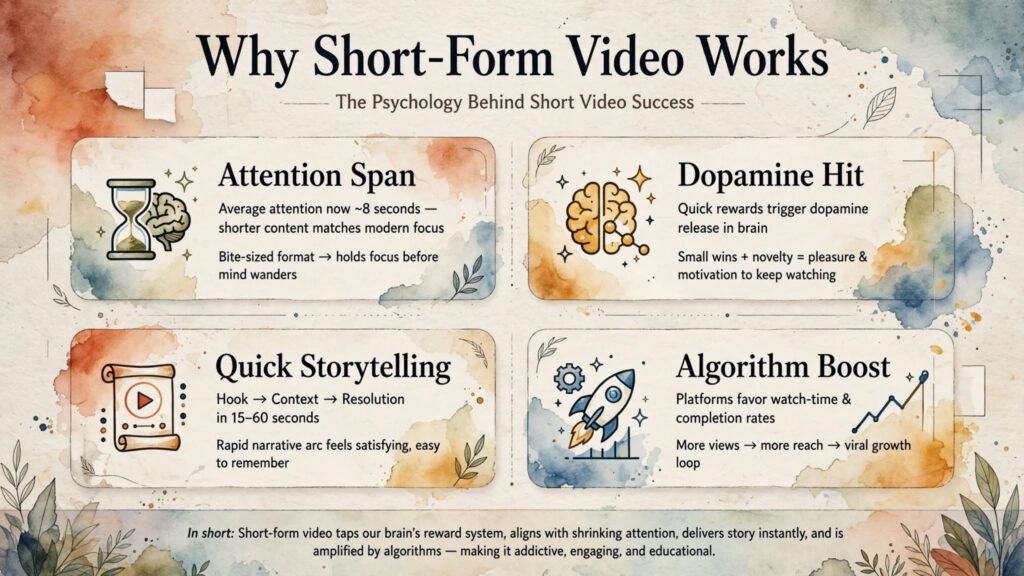
One of the biggest reasons short-form video marketing works is its ability to capture attention quickly. Unlike long-form content, short videos can communicate a single idea within seconds. A strong opening hook, engaging visuals, captions, music, storytelling, or a valuable tip can encourage viewers to continue watching and interacting with the content.
Short-form videos are also highly shareable. Users can easily like, comment on, save, and share videos with others, helping brands increase organic reach. This makes short-form video particularly useful for building awareness, increasing engagement, showcasing products, educating customers, and generating leads.
Another advantage is that businesses can create multiple pieces of content from a single idea. A blog topic, customer question, product feature, or industry tip can become several short videos. This makes short-form video marketing a practical approach for maintaining consistent content while supporting broader social media marketing trends.
Platforms Businesses Should Focus On
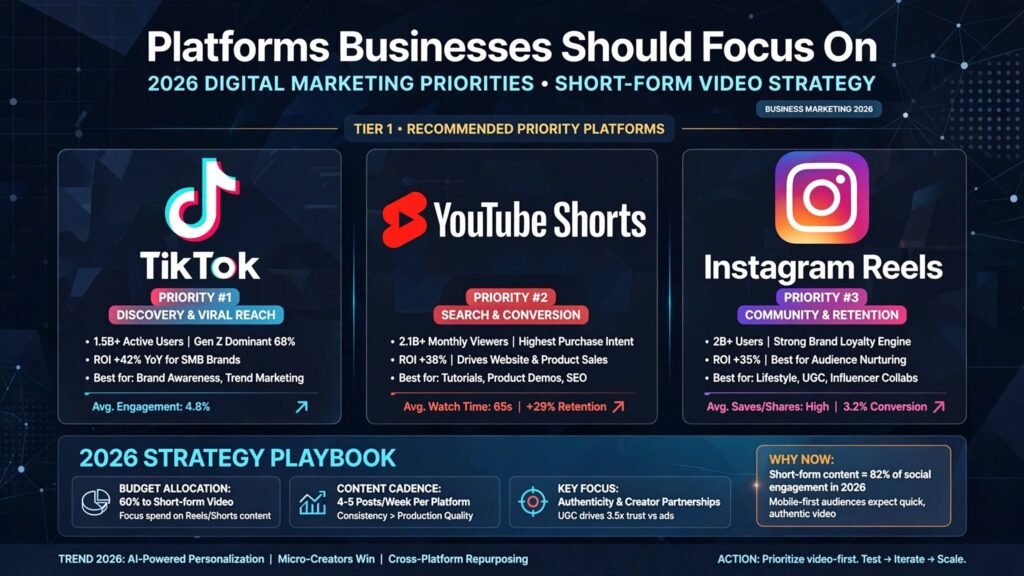
Instagram Reels should remain an important channel for businesses that want to reach audiences through visual and engaging content. Brands can use Reels for product demonstrations, educational tips, behind-the-scenes content, customer testimonials, trends, and promotional campaigns. Consistent publishing combined with relevant keywords, captions, and hashtags can strengthen social discovery.
YouTube Shorts provides another powerful opportunity within video marketing trends. Because YouTube is also a major search platform, businesses can combine short-form video with searchable topics and educational content. Shorts can introduce viewers to a brand and encourage them to explore longer videos, websites, or other resources.
Facebook Reels can help businesses reach existing followers as well as new audiences. Local businesses, service providers, e-commerce brands, and creators can use Facebook Reels to repurpose suitable content and maintain visibility across Facebook’s ecosystem.
Overall, short-form video marketing should not be treated simply as a trend. It can become a consistent part of a broader content strategy. Businesses that focus on strong hooks, valuable information, authentic storytelling, and consistent publishing can use Instagram Reels, YouTube Shorts, and Facebook Reels to strengthen reach and engagement in 2026. As social media marketing trends continue to evolve, short-form video will remain an important tool for connecting brands with modern audiences.
5. Social Media Is Becoming a Search Engine
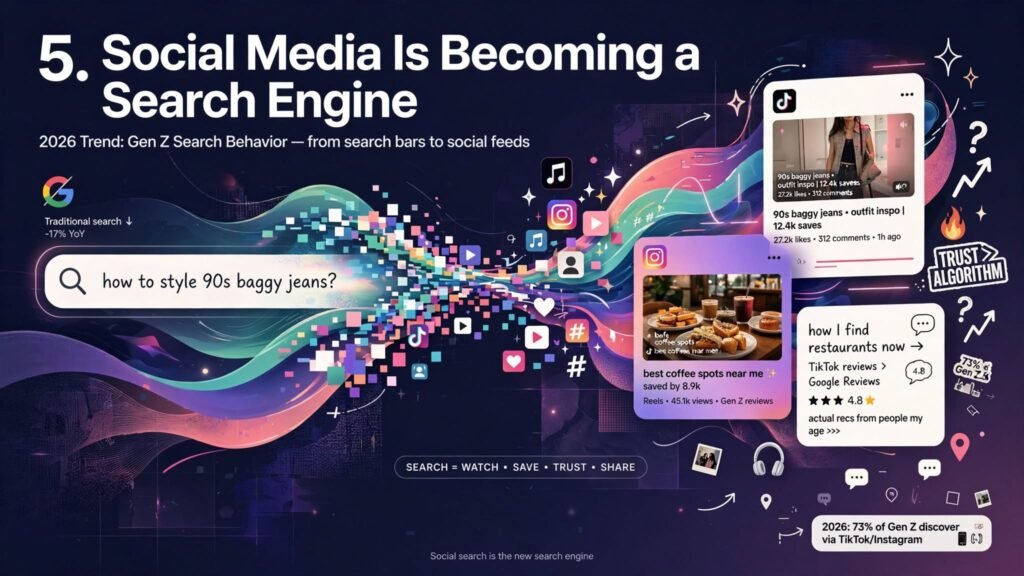
Social media platforms are no longer used only for entertainment, communication, and content sharing. They are increasingly becoming discovery platforms where people search for products, services, reviews, recommendations, tutorials, and businesses. This shift is making social media SEO an important part of modern digital marketing and one of the significant social media marketing trends for 2026. Businesses that optimize their social content for search can increase their chances of being discovered by users who are actively looking for relevant information.
Instagram Search
Instagram search is becoming increasingly important for brands, creators, and local businesses. Users can search for topics, products, services, locations, creators, and specific types of content directly within Instagram. Businesses can improve discoverability by using relevant keywords in their profile name, bio, captions, content topics, and on-screen text.
This makes keyword optimization an important part of Instagram content strategy. Instead of relying only on hashtags, businesses should create content around the actual phrases and questions their target audience searches for. Relevant captions and clear content descriptions can also support stronger social SEO.
TikTok Search
TikTok search has also become an important discovery behavior, particularly for younger audiences. Users may search for tutorials, product recommendations, reviews, trends, recipes, educational content, and solutions to specific problems.
For businesses, this creates an opportunity to combine engaging videos with strategic keyword optimization. Including relevant search terms naturally in spoken content, captions, titles, and on-screen text can help make videos more understandable and discoverable. The focus should remain on creating useful content rather than simply adding keywords.
YouTube Search
YouTube has long functioned as a search engine, making YouTube search an essential part of video discovery. Users frequently search for how-to guides, product comparisons, educational videos, reviews, and solutions to problems.
Businesses can improve YouTube discoverability by researching relevant keywords and using them naturally in video titles, descriptions, scripts, and supporting content. Combining social SEO with traditional SEO principles can help businesses reach audiences at different stages of the customer journey.
Keyword Optimization and Social SEO
The growth of social search means keyword optimization is no longer limited to websites and Google search results. Businesses should understand what their audience searches for on different platforms and create content around those search behaviors.
Effective social media SEO involves using relevant keywords, clear descriptions, searchable topics, strong content structure, and audience-focused messaging. It also means understanding platform-specific search behavior instead of copying the same strategy everywhere.
As one of the major social media marketing trends, social search creates an opportunity for brands to generate visibility beyond traditional search engines. Businesses that optimize their Instagram, TikTok, and YouTube content for discovery can build stronger organic reach and brand awareness.
To develop a consistent strategy across social platforms, businesses can also explore Social Media Marketing services that combine content planning, keyword optimization, audience targeting, and performance analysis.
6. Personalized Marketing Will Drive Better Conversions
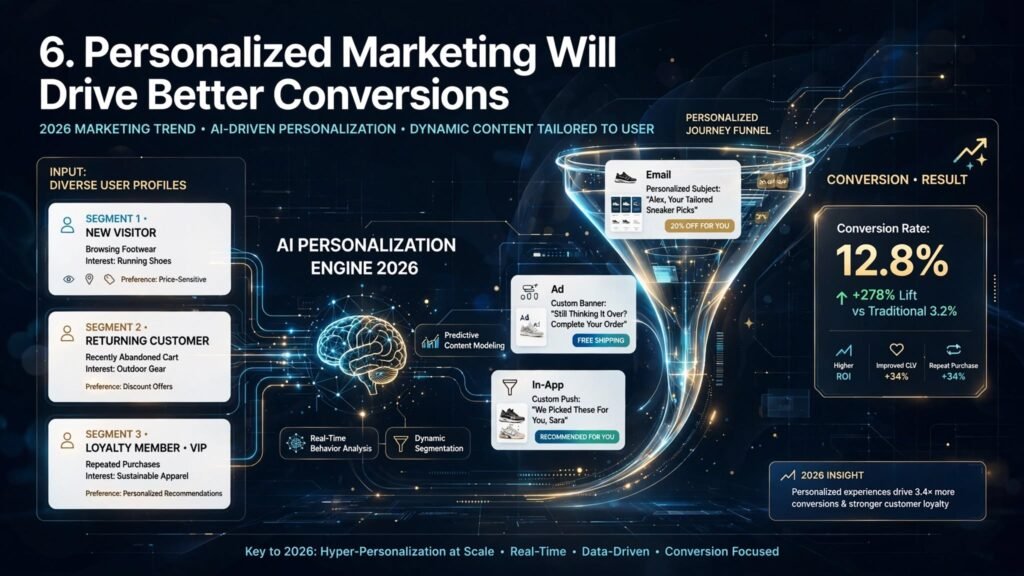
Customers today expect brands to understand their needs, interests, preferences, and buying behavior. Generic messages are becoming less effective as audiences are exposed to large amounts of marketing content every day. This is why personalized marketing is becoming an important part of modern digital marketing strategies. By using data and customer insights, businesses can deliver more relevant experiences, improve engagement, and create stronger opportunities for conversions.
Personalized Content
Personalized content allows businesses to communicate with different customers based on their interests, needs, and position in the buying journey. Instead of showing exactly the same message to everyone, marketers can adapt content according to audience preferences.
For example, a new visitor may receive educational content about a product, while an existing customer may receive content about advanced features, complementary products, or loyalty benefits. This approach makes communication more relevant and supports a better customer experience.
With the help of AI and marketing automation, businesses can also personalize emails, website recommendations, advertisements, and social media campaigns at scale. This makes marketing personalization easier to implement across multiple digital channels.
Audience Segmentation
Effective personalized marketing starts with understanding that not every customer has the same needs. Audience segmentation allows marketers to divide a larger audience into smaller groups based on factors such as demographics, interests, location, purchase history, engagement, or customer journey stage.
For example, an e-commerce business could create separate segments for first-time visitors, repeat customers, inactive customers, and high-value buyers. Each segment can then receive a different message or offer. This improves relevance and allows marketers to create more focused campaigns.
Behavioral Data
Behavioral data provides valuable information about how customers interact with a business. Website visits, pages viewed, products searched, previous purchases, email interactions, and advertising engagement can help marketers understand customer intent.
Using behavioral data responsibly can help businesses identify what customers are interested in and when they may be ready to take action. Marketers can then use these insights to improve content, advertising, product recommendations, and customer journeys.
However, businesses should always prioritize transparency, responsible data usage, and customer privacy when implementing marketing personalization.
Customized Offers
Customized offers can make marketing messages more relevant and potentially improve conversion opportunities. A customer who has previously shown interest in a particular product category may receive a relevant recommendation, discount, bundle, or promotional message rather than a generic offer.
The combination of personalized marketing, audience segmentation, behavioral data, personalized content, and customized offers can create a more relevant customer journey. In 2026, businesses that focus on meaningful marketing personalization can move beyond simply reaching large audiences and instead focus on delivering the right message to the right customer at the right stage.
Ultimately, successful personalized marketing is not about making every interaction feel automated. It is about using useful customer insights to create a better customer experience, stronger engagement, and more relevant conversion opportunities.
7. Content Marketing Is Moving Toward Quality Over Quantity
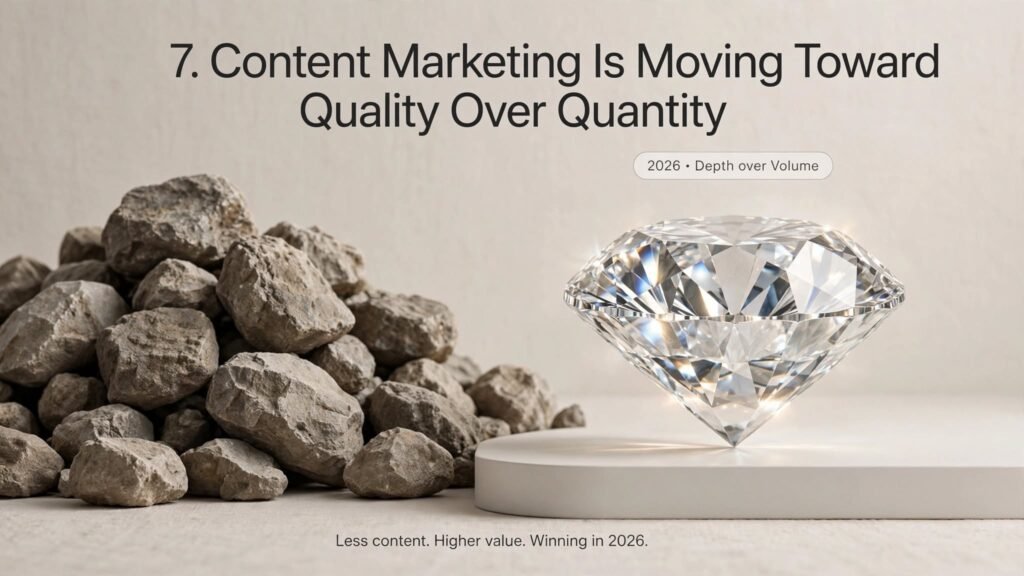
The digital landscape is becoming more crowded every day. Businesses are publishing blogs, social media posts, videos, guides, and promotional content at a faster rate than ever before. However, simply producing more content does not guarantee better visibility or conversions. One of the important content marketing trends for 2026 is the shift from quantity-focused publishing toward useful, original, and audience-focused content. A successful content marketing strategy should focus on answering real questions, solving problems, demonstrating expertise, and creating long-term value.
What High-Quality Content Looks Like
High-quality SEO content starts with original insights. Instead of repeating information that already exists across hundreds of websites, businesses should add unique perspectives, practical examples, research, analysis, or experiences. Original information gives audiences a reason to trust and remember a brand.
Another important factor is search intent. Before creating content, marketers should understand what users actually want when they search for a particular keyword. Someone searching for an informational query may want an explanation or guide, while someone searching for a commercial keyword may be comparing services or products. Aligning content with search intent helps create more relevant SEO content.
First-hand experience is also becoming increasingly valuable. Content that demonstrates real-world knowledge, examples, processes, case studies, results, or practical lessons can provide more value than generic information. Businesses should use their actual expertise to make their content marketing strategy more credible and useful.
Another essential element is helpful content. Content should be created primarily to help the audience rather than simply to include keywords. Clear explanations, actionable advice, relevant examples, useful statistics, and easy-to-follow structures can make content more valuable to readers.
Strong E-E-A-T signals—Experience, Expertise, Authoritativeness, and Trustworthiness—can further strengthen content quality. Businesses can demonstrate these signals by identifying knowledgeable authors, providing accurate information, referencing reliable sources, showcasing practical experience, maintaining updated content, and being transparent about their products or services.
This does not mean keywords are no longer important. Keywords remain useful for understanding search demand and creating relevant SEO content, but they should be integrated naturally into content that genuinely satisfies the reader.
The modern content marketing strategy is therefore moving toward depth, usefulness, originality, and trust. Businesses should focus on creating fewer but stronger pieces of content instead of publishing large volumes of repetitive material.
As content marketing trends continue to evolve in 2026, brands that consistently provide original insights, satisfy search intent, demonstrate first-hand experience, and deliver helpful content can build stronger relationships with their audiences while supporting long-term organic visibility.
For businesses looking to build a strategic content system around SEO, audience needs, and measurable growth, professional Content Marketing can help turn valuable expertise into content that attracts, educates, and converts the right audience.
8. Performance Marketing Will Focus More on ROI
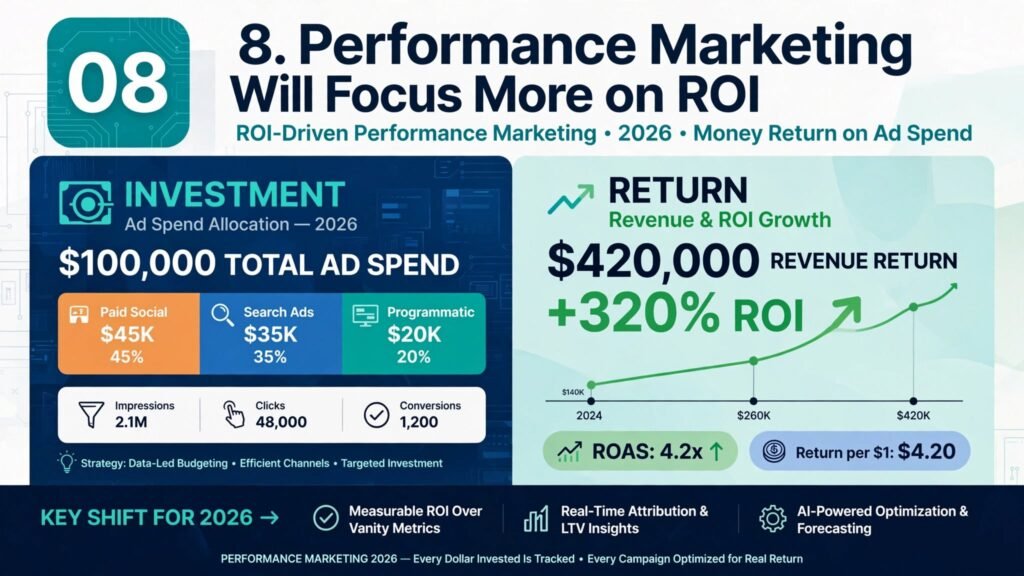
Digital advertising is becoming increasingly measurable, and businesses are paying closer attention to the actual return generated by their marketing investments. This is why performance marketing is becoming more focused on marketing ROI rather than vanity metrics such as impressions, likes, or clicks alone. One of the major digital advertising trends in 2026 is the shift toward measurable business outcomes, where campaigns are evaluated based on leads, sales, revenue, customer acquisition costs, and overall profitability.
Conversion Tracking
Accurate conversion tracking is the foundation of effective performance marketing. Businesses need to understand what happens after someone clicks an advertisement. A conversion could be a purchase, form submission, phone call, WhatsApp inquiry, app installation, or another valuable action.
Without reliable conversion tracking, marketers may optimize campaigns based on incomplete information. Tracking conversions allows businesses to identify which advertisements, audiences, keywords, and channels are generating meaningful results.
ROAS
ROAS (Return on Ad Spend) is another important metric in performance marketing. It helps businesses understand how much revenue is generated compared with the amount spent on advertising.
For example, if a business spends ₹10,000 on an advertising campaign and generates ₹40,000 in attributed revenue, the campaign produces a 4x ROAS. However, ROAS should not be viewed in isolation. Businesses should also consider product margins, operational costs, customer acquisition costs, and lifetime customer value when evaluating marketing ROI.
Lead Quality
Generating a large number of leads does not necessarily mean a campaign is successful. Lead quality is becoming increasingly important in modern performance marketing. A campaign that generates 500 irrelevant inquiries may deliver less business value than a campaign generating 100 highly qualified leads.
Marketers should therefore evaluate whether leads match the target audience, show genuine purchase intent, and eventually convert into customers. Connecting advertising data with CRM and sales information can provide a clearer picture of actual campaign performance.
Campaign Optimization
Continuous campaign optimization is essential for improving advertising performance. Marketers can analyze audience behavior, creative performance, conversion rates, keywords, landing pages, and spending patterns to identify opportunities for improvement.
Instead of launching a campaign and leaving it unchanged, businesses should continuously test different creatives, audiences, messages, offers, and landing pages. This ongoing optimization can help improve efficiency and strengthen marketing ROI.
Data-Driven Advertising
The growth of data-driven advertising is one of the most important digital advertising trends shaping modern marketing. Businesses can use performance data to make better decisions about where to invest their budgets and which campaigns deserve additional attention.
Ultimately, performance marketing is moving away from simply generating visibility and toward measurable business results. By combining accurate conversion tracking, ROAS analysis, lead quality evaluation, continuous campaign optimization, and data-driven advertising, businesses can make their advertising budgets more accountable and build strategies focused on sustainable marketing ROI.
9. Google Ads and Meta Ads Are Becoming More Automated
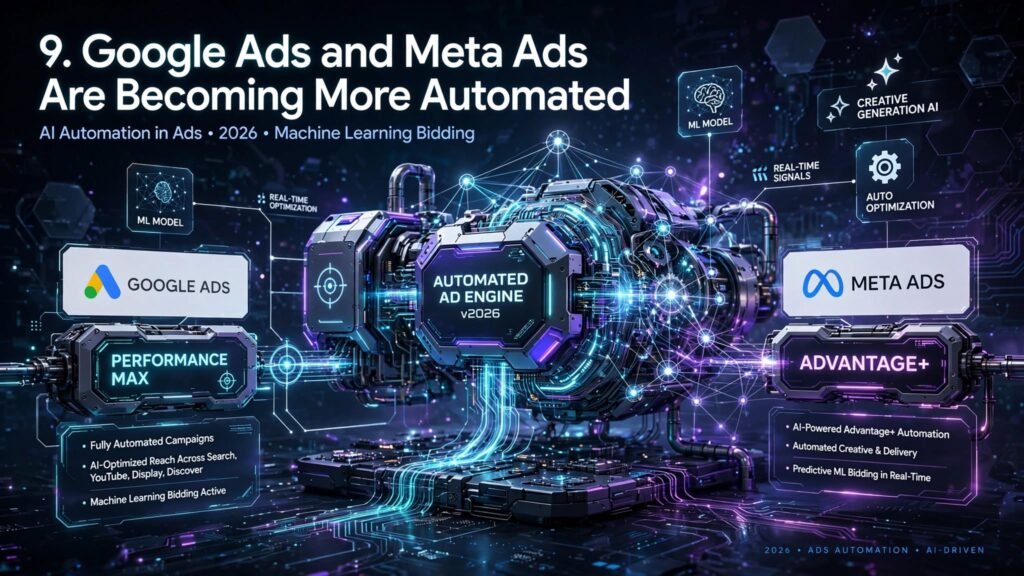
Paid advertising is becoming increasingly intelligent as advertising platforms use machine learning and automation to improve campaign performance. Google Ads and Meta Ads are both introducing more automated features that can help businesses manage targeting, bidding, placements, creative delivery, and campaign optimization. This is making PPC advertising more efficient, but it also means marketers need to understand how automation works and where human strategy remains essential.
Google Ads Automation
Google Ads uses automation across several areas of PPC advertising, including smart bidding, audience targeting, ad delivery, keyword management, and campaign optimization. Automated bidding can use signals such as device, location, time, audience behavior, and conversion likelihood to adjust bids according to campaign objectives.
Google’s automated campaign features can reduce manual work and help advertisers respond to large amounts of data more efficiently. However, automation still depends on the quality of conversion data, campaign structure, creative assets, landing pages, and business goals. Poor inputs can lead to poor optimization, making strategic planning an important part of successful Google Ads campaigns.
Meta Ads Automation
Meta Ads is also becoming increasingly automated. Meta’s advertising system can use machine learning to identify people who are more likely to take a desired action and optimize ad delivery accordingly. Automated audience expansion, placements, creative combinations, and campaign optimization can help advertisers reach potential customers across Meta’s platforms.
For businesses using paid advertising, this automation can save time and allow campaigns to process large amounts of audience and performance data. However, marketers still need to provide strong creative assets, clear offers, accurate tracking, and appropriate campaign objectives for automation to work effectively.
Why Human Strategy Still Matters
Although automation is becoming a major part of Google Ads and Meta Ads, human strategy remains important. Advertising platforms can optimize toward the goals and signals they receive, but they cannot fully understand a company’s positioning, customer psychology, competitive environment, profitability, or long-term business objectives.
A skilled marketer can determine the right target audience, develop compelling messaging, choose appropriate offers, analyze PPC advertising performance, and identify when a campaign needs a strategic change. Humans are also responsible for evaluating lead quality and ensuring that advertising performance supports actual business outcomes rather than vanity metrics.
The future of paid advertising is therefore not simply about automation replacing marketers. It is about combining platform automation with human expertise. Businesses that use automated tools while maintaining strong strategy, creative direction, tracking, and optimization can make their advertising campaigns more efficient and measurable.
For businesses looking to generate targeted leads and sales through paid campaigns, professional Google Ads and Meta Ads strategies can help combine automation with human-led campaign planning and optimization.
10. First-Party Data Will Become More Important
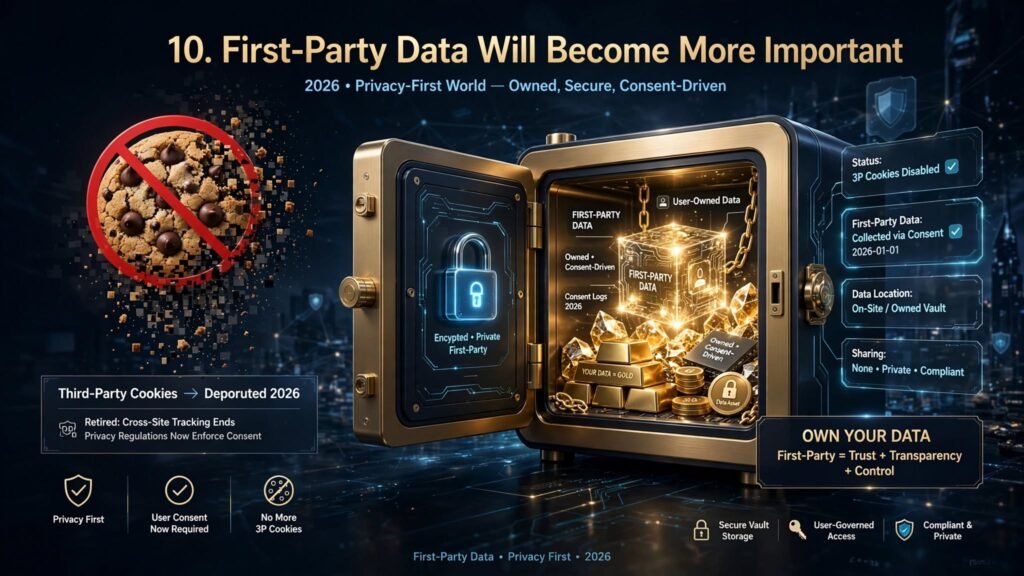
As digital marketing becomes more privacy-focused, businesses are placing greater importance on information collected directly from their own customers and audiences. This is known as first-party data, and it is becoming an important part of modern marketing strategies. Instead of depending heavily on external data sources, businesses can use their own customer data to understand audience behavior, improve personalization, build stronger relationships, and create more relevant marketing campaigns. This shift is one of the important developments in privacy marketing for 2026.
Cookies and Privacy Changes
Changes in browser privacy policies, tracking technologies, and consumer expectations are changing how businesses collect and use data. Users are becoming more aware of how their information is handled and increasingly expect businesses to provide transparency and responsible data practices.
These changes make first-party data more valuable because businesses can collect information directly through legitimate customer interactions, with appropriate consent and privacy practices. Instead of relying entirely on third-party tracking, marketers can build direct relationships with their audiences.
CRM Data
A Customer Relationship Management (CRM) system can become an important source of customer data. Information such as customer interactions, purchase history, inquiries, preferences, and communication records can help businesses understand their existing audiences.
When managed responsibly, CRM data can support better audience segmentation, lead nurturing, customer retention, and personalized marketing. It can also help businesses connect marketing activities with actual customer outcomes.
Email Marketing
Email marketing is another effective channel for building and using first-party data. When customers voluntarily subscribe to newsletters, updates, offers, or educational content, businesses can develop a direct communication channel with them.
Email lists can be segmented according to customer interests, engagement levels, purchase history, or funnel stage. This allows marketers to send more relevant messages instead of treating every subscriber in exactly the same way.
Lead Forms
Website and advertising lead forms can also help businesses collect valuable information directly from potential customers. Depending on the business model, forms may collect details such as name, email address, phone number, service requirements, or product interests.
The quality of collected first-party data depends on the relevance of the questions and the overall user experience. Businesses should avoid collecting unnecessary information and clearly communicate how submitted data will be used.
Customer Databases
A well-organized customer database can become a valuable long-term marketing asset. Businesses can use customer information to understand buying patterns, identify repeat customers, develop retention campaigns, and create relevant offers.
However, effective privacy marketing requires more than simply collecting data. Businesses need appropriate consent, secure data handling, transparency, and responsible usage practices.
As privacy expectations continue to evolve, first-party data will become increasingly important for sustainable digital marketing. Businesses that build trusted relationships and responsibly collect customer data through CRM systems, email marketing, lead forms, and customer databases can create stronger foundations for personalization and long-term customer engagement.
How to Build a Digital Marketing Strategy for 2026
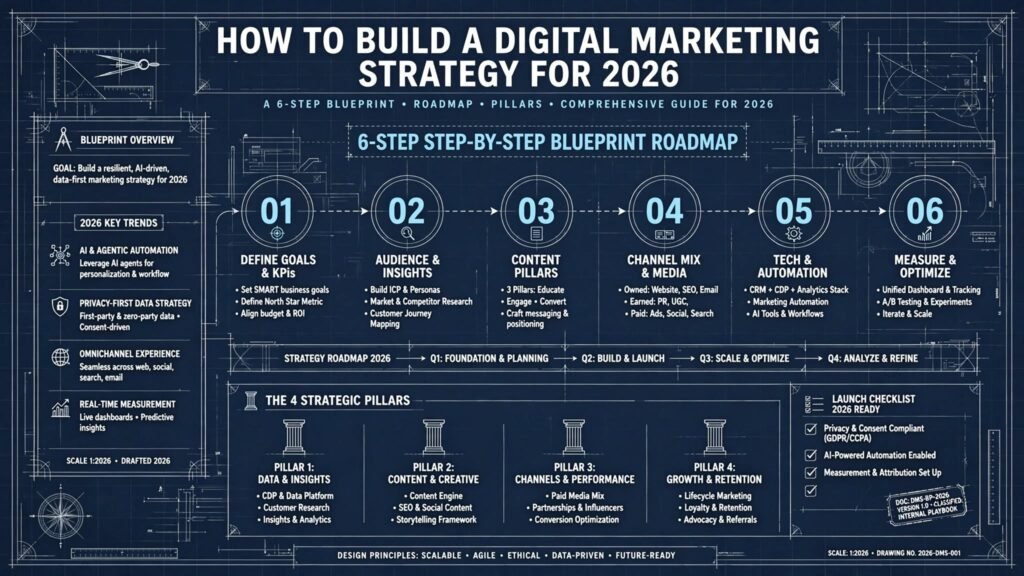
Creating a successful digital marketing strategy 2026 requires more than simply posting content or running advertisements. Businesses need a structured digital marketing plan that connects their audience, goals, marketing channels, content, and performance data. As AI, social search, automation, personalization, and changing customer behavior continue to influence digital marketing, businesses should build flexible strategies that can adapt to new opportunities. The following five steps can help create a practical and results-focused digital marketing strategy 2026.
Step 1 — Define Your Target Audience
The first step in any effective digital marketing plan is understanding who you want to reach. Define your target audience based on demographics, interests, location, problems, purchasing behavior, and online activities. Creating detailed buyer personas can help you understand what your customers need and what influences their purchasing decisions.
A clear target audience also helps businesses choose the right keywords, content formats, advertising platforms, and communication style.
Step 2 — Set Measurable Goals
Your digital marketing strategy 2026 should have specific and measurable objectives. Instead of setting a vague goal such as “increase online presence,” define measurable targets such as generating qualified leads, increasing website conversions, improving organic traffic, growing sales, or achieving a specific return on advertising spend.
Using measurable goals allows businesses to evaluate whether their digital marketing plan is producing meaningful results.
Step 3 — Choose the Right Channels
Not every business needs to use every digital marketing channel. Select platforms based on your target audience, business objectives, budget, and customer journey.
Depending on the business, the right combination may include SEO, Google Ads, Meta Ads, social media marketing, email marketing, content marketing, video marketing, or AI search optimization. A focused digital marketing strategy 2026 can often produce better results than spreading resources across too many channels without a clear purpose.
Step 4 — Create Valuable Content
Content should provide genuine value rather than simply promote products or services. Your digital marketing plan should include educational articles, videos, social media content, guides, case studies, product information, and other formats that answer customer questions.
Content should also align with search intent and customer journey stages. High-quality content can support SEO, social search, brand authority, engagement, and conversions simultaneously.
Step 5 — Track and Optimize Performance
A digital marketing strategy 2026 should never remain static. Use analytics and conversion tracking to understand which channels, campaigns, keywords, advertisements, and content pieces are generating results.
Regular campaign optimization allows businesses to identify what is working and what needs improvement. Monitor metrics such as traffic, engagement, conversion rate, cost per lead, customer acquisition cost, and ROI.
Ultimately, a successful digital marketing plan is a continuous process of planning, implementing, measuring, and improving. Businesses that combine a clear audience, measurable goals, appropriate channels, valuable content, and consistent optimization can build a more adaptable and results-driven digital marketing strategy 2026.
Which Digital Marketing Trends Should Your Business Follow?
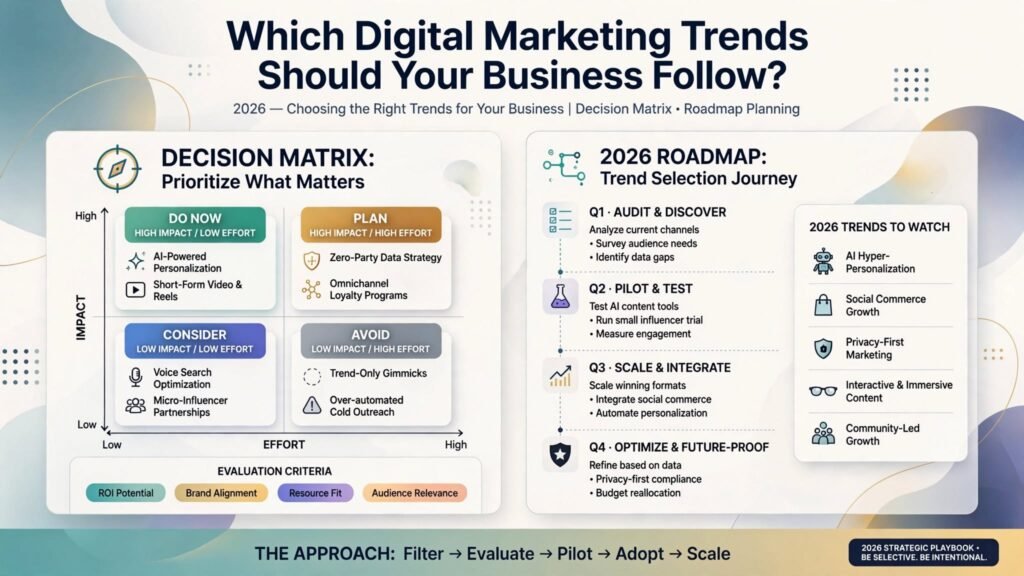
Not every business needs to follow every digital marketing trend. The right approach is to choose strategies according to your business model, target audience, goals, budget, and customer journey. A strong digital marketing strategy focuses on the channels that can create meaningful visibility, engagement, leads, and sales instead of trying to be present everywhere.
Small Business — Local SEO + Social Media
For a small business, Local SEO and social media marketing can be highly useful for building awareness within a specific geographic area. Optimizing the Google Business Profile, creating location-focused content, collecting genuine customer reviews, and maintaining an active social media presence can help local customers discover the business.
Combining Local SEO with social media can create a stronger digital marketing strategy for businesses that depend on nearby customers.
E-commerce — Meta Ads + Google Ads
For e-commerce businesses, Meta Ads and Google Ads can support product discovery, traffic generation, retargeting, and conversions. Google Ads can help businesses reach customers actively searching for products, while Meta Ads can introduce products to relevant audiences based on interests and behaviors.
A data-driven advertising strategy combined with strong product pages and conversion tracking can make these channels more effective.
B2B — SEO + Content Marketing
B2B businesses often have longer buying cycles and customers who conduct extensive research before making decisions. For this reason, SEO and Content Marketing can play an important role in a B2B digital marketing strategy.
Educational blogs, industry guides, case studies, research-based content, and detailed service pages can demonstrate expertise and attract potential customers searching for solutions.
Personal Brand — Short-Form Video + Social SEO
For a personal brand, short-form video and Social SEO can help build visibility and authority. Instagram Reels, YouTube Shorts, and other short-form formats allow individuals to share knowledge, opinions, experiences, tutorials, and stories in an engaging way.
Optimizing profiles and content around relevant keywords can also help people discover personal brands through social search.
Service Business — Local SEO + Lead Generation
For service businesses, Local SEO combined with lead generation can create a focused customer acquisition strategy. Optimized service pages, local search visibility, reviews, lead forms, and targeted advertising can help potential customers find and contact the business.
The key is to connect marketing visibility with a clear conversion path, such as a consultation request, phone call, inquiry form, or WhatsApp conversation.
Ultimately, the best digital marketing strategy depends on your business objectives rather than simply following every new digital marketing trend. A small local business may benefit more from Local SEO and social media, while an e-commerce brand may prioritize paid advertising. B2B companies can focus on SEO and content, whereas personal brands may benefit from video and Social SEO.
The most effective approach is to identify where your customers spend their time, understand how they search for solutions, and select the digital marketing trends that directly support your business goals.
Frequently Asked Questions
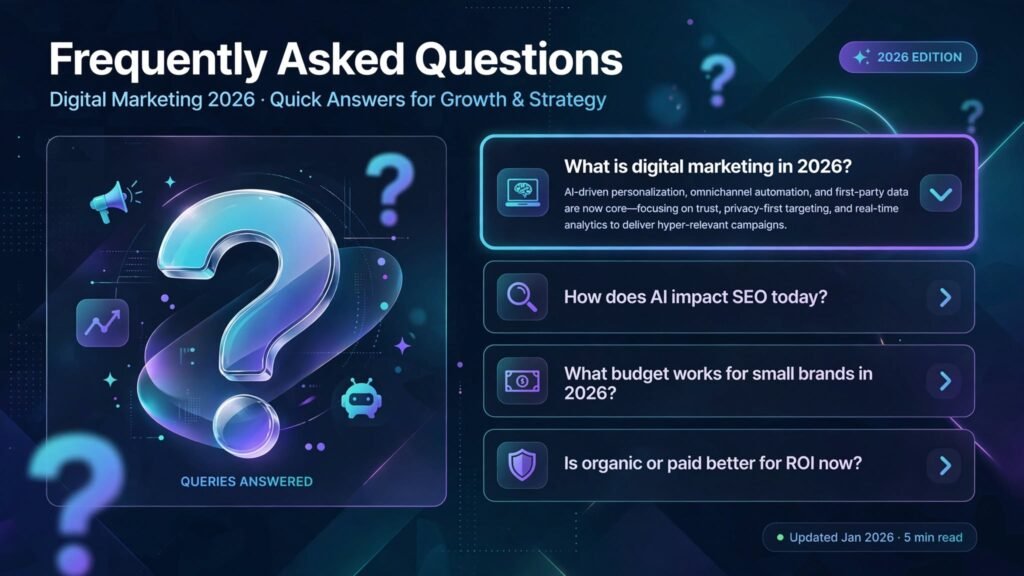
What are the biggest digital marketing trends in 2026?
Some of the biggest digital marketing trends 2026 include AI marketing, AI Search Optimization, zero-click search, short-form video, social media SEO, personalized marketing, quality-focused content marketing, performance marketing, advertising automation, and first-party data. Businesses should select trends according to their audience, industry, goals, and available resources rather than trying to implement every trend at once.
How is AI changing digital marketing?
AI is changing digital marketing by helping businesses automate repetitive tasks, analyze customer behavior, generate content ideas, personalize marketing experiences, and improve campaign optimization. AI in digital marketing can support predictive analytics, audience segmentation, customer insights, advertising optimization, and marketing automation. However, human strategy, creativity, brand understanding, and decision-making remain important for achieving meaningful results.
Is SEO still important in 2026?
Yes, SEO is still important in 2026, but the search landscape is evolving. Businesses now need to think beyond traditional rankings and consider AI search, zero-click results, social search, featured snippets, and other discovery experiences. Modern SEO should focus on helpful content, search intent, technical performance, topical authority, user experience, and trustworthy information. Combining traditional SEO with AI Search Optimization can help businesses adapt to changing search behavior.
What is AI Search Optimization?
AI Search Optimization is the process of creating and structuring online information so that it can be better understood and potentially surfaced by AI-powered search experiences. It builds on traditional SEO principles such as high-quality content, relevant keywords, clear structure, internal linking, and authoritative information while considering how AI systems understand and present information. AI Search Optimization and GEO are becoming important areas of modern search strategy.
Which digital marketing strategy is best for small businesses?
There is no single digital marketing strategy that is best for every small business. However, Local SEO, social media marketing, content marketing, lead generation, and carefully targeted paid advertising can be valuable depending on the business model. A small local business may prioritize Local SEO and social media, while an online service business may focus more heavily on SEO, content, Google Ads, or Meta Ads. The right digital marketing strategy should be based on the target audience, business goals, budget, competition, and customer journey.
Conclusion
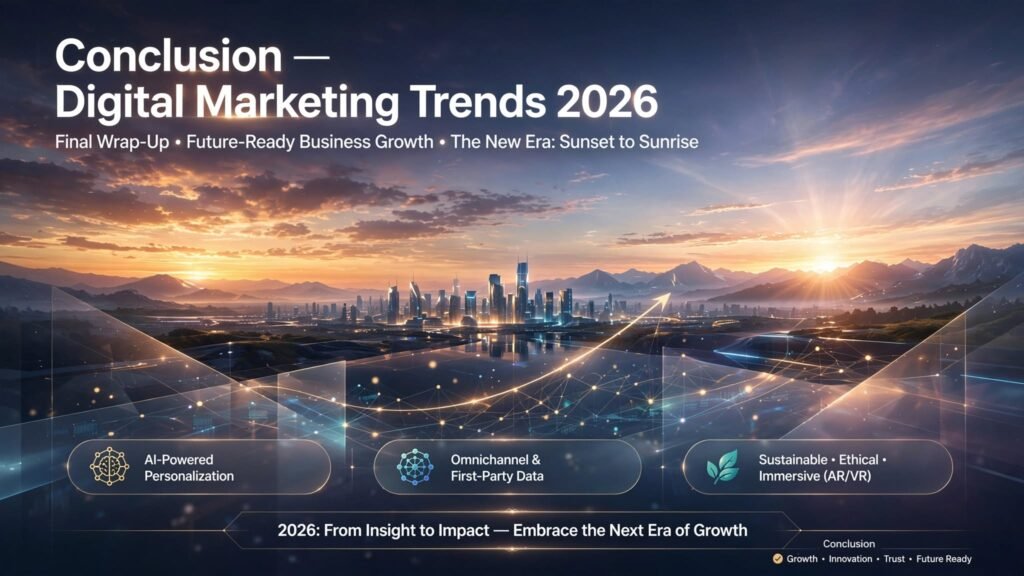
The digital marketing trends 2026 are clearly showing one major shift: successful marketing is no longer about simply being present on every platform. It is about using the right technology, understanding customer behavior, creating valuable experiences, and building a digital marketing strategy that delivers measurable business results. From AI marketing and AI-powered search to personalization, short-form video, social search, performance advertising, and first-party data, the digital landscape is becoming smarter, faster, and more customer-focused.
One of the biggest changes in 2026 is the growing role of AI in digital marketing. AI can help businesses analyze data, automate repetitive tasks, understand customer intent, personalize campaigns, generate content ideas, and improve advertising performance. However, AI should not replace human creativity and strategic thinking. The strongest marketing approach combines artificial intelligence with human experience, creativity, brand understanding, and customer psychology.
Search is also evolving rapidly. Traditional SEO remains important, but businesses now need to consider AI search optimization, zero-click searches, social search, and changing discovery behavior. Customers can discover brands through Google, AI-powered search experiences, Instagram, TikTok, YouTube, and other digital platforms. This means businesses need a broader approach to visibility rather than relying only on website traffic.
At the same time, personalization and video are becoming increasingly important. Customers expect relevant content, useful recommendations, personalized communication, and engaging visual experiences. Short-form video can help brands capture attention, while personalized marketing can turn that attention into meaningful engagement and conversions.
However, businesses should not blindly follow every digital marketing trend. A trend may be popular, but that does not automatically mean it is right for every business. The best digital marketing strategy depends on your target audience, industry, business model, budget, objectives, and customer journey. A local business may benefit more from Local SEO and social media, while an e-commerce brand may prioritize Google Ads, Meta Ads, and conversion optimization.
The real advantage in 2026 will come from combining data + creativity + AI. Data helps businesses understand what is working, creativity helps brands stand out, and AI helps marketers work faster and make smarter decisions. When these three elements work together, businesses can create more relevant campaigns, improve customer experiences, increase conversions, and achieve stronger marketing ROI.
Ultimately, the future of digital marketing is not about chasing every new trend. It is about identifying the digital marketing trends 2026 that align with your business goals and turning them into a practical, measurable strategy. Businesses that adapt intelligently, focus on customers, and continuously optimize their approach will be better positioned to grow in the evolving digital landscape.